The 5-step wine tasting method is a structured sensory sequence of See, Swirl, Smell, Sip, and Savor. It splits appearance, aroma, palate, and finish into separate observations so a taster records evidence before assigning any verdict — the same logic that powers the WSET Systematic Approach to Tasting and Wine Folly’s Five S’s framework.
We’re not teaching a party trick here. According to the Wine Institute, American adults drank 2.54 gallons of wine per resident in 2024 (870 million gallons in total), and the WSET reported 134,000 candidates sat one of its qualifications in 2023–24. That is a lot of people drinking, and a growing number learning to describe it accurately. This guide walks through preparation, the five sensory steps, a scoring grid, common misreadings, and comparison drills that build durable sensory memory.
Most “Five S’s” guides — Ourglass, Wiens Cellars, Wine Folly — teach the sequence well but stop at the metaphor. They rarely connect each step to measurable sensory science, and almost none cite year-anchored data. Ours does. We anchor every claim to research, and we add the market context that makes structured tasting more useful now, not less: Silicon Valley Bank’s 2025 report put U.S. wine shipments at roughly 329 million cases, down from 335.9 million, with value slipping from $75.5 billion to $74.3 billion. In a shrinking market, choosing the right bottle depends on knowing how to evaluate one.
Prepare for the Five-Step Wine Tasting Method: Glassware, Temperature, Order, and Etiquette
Preparation removes the variables that would otherwise masquerade as the wine’s own character. Clean neutral glassware, correct serving temperature, consistent pours, a logical tasting order, and proper spitting etiquette produce comparisons we can trust.
“The systematic approach is designed to help the taster reach a conclusion about the quality and readiness for drinking of a wine.” — WSET, Systematic Approach to Tasting
How should you hold, pour, and serve wine before tasting?
Hold a stemmed glass by the stem or foot, pour to roughly the widest point of the bowl, and serve every sample in the same style of glass. Holding the bowl warms the wine and leaves fingerprints that blur visual inspection, so the WSET and the Society of Wine Educators both direct tasters to grip the stem or base instead.
Filling to the widest point rather than the rim leaves an aroma chamber above the liquid where volatile compounds collect when you swirl. A modest pour also lets you repeat an observation without exhausting the sample. Serve within a temperature range, not by the oversimplified “red warm, white cold” rule: WSET’s Level 3 specification places many sparkling and light whites around 6–10°C, fuller whites around 10–14°C, and many reds around 15–18°C. Excess warmth emphasizes alcohol; excess chill suppresses aroma.
What tasting order works best for comparing wines side by side?
A dependable order moves from lighter, less intense wines to fuller, sweeter, more tannic, or more strongly oaked ones. The WSET and the Court of Master Sommeliers both use this progression because a powerful wine will flatten your perception of everything that follows.
For a first controlled flight, compare three wines from the same grape at different price points or climates. That holds one variable steady while exposing real differences in acidity, ripeness, alcohol, and oak.
When should you spit wine, and how do you cleanse your palate?
Spit when the goal is comparison, study, or responsible tasting rather than consumption. Professional training programs treat spitting as standard because alcohol and fatigue distort later judgments even in small pours.
Lean close to a covered spittoon and expel the wine with controlled pressure rather than swallowing. Between samples, drink still water and reach for unseasoned, neutral food — plain bread or unsalted crackers — only if your palate needs a reset. Strongly flavored food defeats the purpose of the exercise.
See, Swirl, Smell: The First Three Steps for Appearance and Aroma
See, Swirl, and Smell establish visual condition, aromatic intensity, and potential flavor clues before a single drop crosses your lips. Both Wine Folly’s Five S’s and the WSET sequence treat aroma recognition as a skill to develop, never a requirement for competent tasting.
See: How do color, clarity, intensity, and viscosity guide observation?
See the wine against a white background and record clarity, color, intensity, and rim variation before swirling. These four observations answer different questions: clarity flags haze, color names the hue, intensity measures concentration of visible color, and viscosity describes how the liquid moves against the glass.
Tilt the glass and inspect the center, edge, and rim. Pale ruby, garnet, straw, gold, and amber are descriptive observations, not quality scores — grape variety, extraction, age, production choices, and oxidation all shift appearance. Watch the legs or tears only as a record of flow, never as an alcohol meter. Alcohol, sugar, temperature, glass shape, and surface tension all shape the pattern, which is why Wine Folly and UC Davis sensory guidance warn against using legs to infer quality or proof.
Swirl: Why does movement release wine aromas?
Swirling increases contact between wine and air, which drives volatile aroma compounds into the space above the liquid. Sensory-science guidance from UC Davis describes headspace concentration and volatilization as the core mechanisms at work.
Swirl gently on a flat surface for a few seconds, then raise the glass and nose it again. The first smell may show delicate or fleeting notes; the second may reveal stronger fruit, floral, spice, oak, or fermentation character. Skip the aggressive swirl on sparkling wine — excessive agitation accelerates carbon-dioxide loss and flattens the very thing you’re there to taste. If you’re curious how aeration compares when it happens in a decanter instead, our guide to how decanting changes what you smell and taste covers that next step.
Smell: How do fruit, floral, herbal, spicy, mineral, wood, and smoke aromas develop?
Smell with two or three short, separate sniffs rather than one long inhalation. WSET and Wine Folly group wine aromas into practical families — fruit, flowers, herbs, spices, earth, minerals, oak, and fermentation-derived notes — a vocabulary that moves you from broad recognition toward specific description.
Aroma terms are sensory comparisons, not literal ingredients. The Wine Aroma Wheel, developed by Ann C. Noble at UC Davis, uses familiar reference words to help tasters communicate what they perceive without claiming those substances were added to the wine.
First published in 1984, the Wine Aroma Wheel compresses a wine’s aromatic vocabulary into 12 major categories, 29 subcategories, and 94 specific terms.
How reliably can you trust that nose? A 2025 study in Nature Communications found that tastes and retronasal odors converge on a shared flavor-specific neural code in the human insula — biological confirmation that what we call “flavor” is an integration, not a single sense.
How can you distinguish primary, secondary, and tertiary aromas while tasting?
Primary aromas mainly reflect the grape and growing environment, secondary aromas arise from winemaking, and tertiary aromas develop through maturation. The WSET and the Oxford Companion to Wine use these categories as organizing tools while acknowledging that real wines blend all three.
| Aroma category | Typical origin | Useful observations |
|---|---|---|
| Primary | Grape and vineyard | Fresh fruit, flowers, herbs, green or black fruit character |
| Secondary | Fermentation and cellar work | Yeast, bread, cream, butter, toast, or oak influence |
| Tertiary | Bottle or barrel development | Dried fruit, leather, tobacco, mushroom, nuts, or earth |
Ask which category best explains an aroma, but record uncertainty when evidence overlaps. A buttery note may involve malolactic conversion, oak, or both — effects that are distinct yet frequently appear together.
Sip: Evaluate Flavor, Texture, Balance, Acidity, Sweetness, Tannin, and Body
Sipping tests whether the palate confirms or contradicts what the nose suggested. The WSET’s palate assessment and the Court of Master Sommeliers’ tasting grids evaluate flavor intensity, structure, texture, alcohol, acidity, sweetness, tannin, body, and balance — never a single impression.
The tongue detects just five basic tastes; berry, floral, and oak notes reach you through the retronasal passage as smell.
How should beginners take a small sip and assess the wine across the palate?
Take a small sip, move the wine across your tongue and cheeks, and track the sequence from entry to mid-palate to exit. Wine Folly’s Five S’s and the WSET both encourage this deliberate movement because acidity, tannin, alcohol warmth, and finish each surface at different moments.
Do not confuse flavor intensity with body. A light-bodied wine can smell powerfully aromatic, while a full-bodied wine may show restrained aroma. The WSET separates aromatic intensity from palate weight for exactly this reason.
What do acidity, sweetness, tannin, alcohol, texture, and body reveal?
These elements reveal the wine’s structural shape and explain why it feels refreshing, rich, drying, soft, or hot. Sensory definitions, not grape names, carry the meaning.
| Element | What you perceive | What to record |
|---|---|---|
| Acidity | Salivation, freshness, tartness | Low, medium, or high; integrated or sharp |
| Sweetness | Residual sugar on the palate | Dry, off-dry, medium, or sweet |
| Tannin | Grip, dryness, texture on gums | Amount, grain, firmness, maturity |
| Alcohol | Warmth and weight | Low, medium, or high; balanced or hot |
| Body | Overall palate weight | Light, medium, or full |
| Texture | Silky, creamy, chalky, coarse, or lean sensation | Shape and tactile quality |
Balance describes the relationship among these components, not the highest value in any single category. A high-acid wine stays balanced when fruit and sweetness support it; a high-alcohol wine tips into imbalance when warmth buries fruit and acidity. WSET examination criteria assess components in relation to one another, and so should you.
Savor: Judge the Finish, Persistence, and Wine Development
Savor measures what remains after the sip leaves your mouth. The WSET defines finish through persistence and quality of flavor, while the Court of Master Sommeliers weighs length, balance, and the character of the aftertaste.
“By some estimates, nearly 80 percent of a food’s flavour is determined by its retronasal sense of smell.” — Charles Spence, Flavour (2015)
What is a wine finish, and how do you measure its length?
A wine finish is the duration and character of flavor and sensation after swallowing or spitting. Measure it with a simple count — short, medium, or long — then describe what persists, because a long finish is not automatically a positive one under the WSET’s quality framework.
Count from the moment the wine leaves your mouth until its identifiable flavor and structural sensations fade. Record fruit, spice, oak, bitterness, acidity, tannin, or alcohol separately. That keeps “long” from becoming an empty synonym for “good.”
How does wine change after swallowing or spitting?
After swallowing or spitting, volatile compounds keep reaching the retronasal passage, so aroma may seem to rise from the back of your mouth. UC Davis sensory research and WSET instruction both distinguish this oral aroma perception from plain nasal sniffing.
Notice whether the wine turns fresher, drier, warmer, more bitter, or more aromatic once the liquid is gone. Swallowing adds alcohol exposure and can intensify warmth; spitting still leaves enough wine-derived sensation to assess the finish. Professional systems therefore allow either approach, depending on the purpose of the session.
What can a long, short, clean, or unbalanced finish actually tell you?
A long, clean, balanced finish usually signals that flavor and structure stay coherent after the sip, whereas a short finish may indicate low concentration, high dilution, or simply a deliberately delicate style. The WSET and the Court of Master Sommeliers treat persistence as one quality indicator among several, not a standalone verdict.
Compare the finish against the wine’s intended style before judging it. A crisp, inexpensive white can succeed without the persistence of a concentrated aged red. Intensity and length only mean something inside context — maximum power is not the universal goal.
Record the Five Steps: A Beginner Wine-Tasting Notes Template and Scoring Grid
Recording each step converts fleeting impressions into comparable evidence. WSET tasting sheets and Wine Folly’s guided notes both separate observation from evaluation, which stops beginners from deciding whether they like a wine before describing it.
What should you write down at See, Swirl, Smell, Sip, and Savor?
Use short descriptors, a sensory intensity level, and one evidence-based conclusion per stage. A useful note records what you perceived before explaining what that perception may indicate.
Write “red berry, medium intensity, medium acidity” instead of “good red wine.” The WSET’s descriptive approach rewards observable structure, and UC Davis sensory practice backs consistent vocabulary for comparing samples.
How can a simple 1-to-5 grid score appearance, aroma, structure, balance, and finish?
A five-point grid creates a repeatable personal benchmark without pretending to be a professional quality scale. The grid below adapts the category logic used by WSET and Wine Folly into a beginner-friendly recording tool.
| Category | 1 | 3 | 5 |
|---|---|---|---|
| Appearance | Hazy or visually inconsistent | Clear, typical intensity | Clear, vivid, distinctive |
| Aroma | Weak or unattractive | Clear and moderate | Intense, complex, clean |
| Structure | Thin or harsh | Recognizable, moderate | Layered, well integrated |
| Balance | One element dominates | Mostly proportionate | All components support one another |
| Finish | Very short or faulty | Moderate and clean | Persistent, clear, balanced |
Score immediately after tasting, then revisit the sheet after five minutes. A changed score records your perception of development rather than proving the wine objectively changed — context, expectation, and palate condition all shape judgments.
Five-Step Wine Tasting Pitfalls: Common Misreadings and Beginner Mistakes
The most common tasting errors come from treating clues as proof. WSET, UC Davis sensory guidance, and the Oxford Companion to Wine all warn against using a single visual, aromatic, or structural feature to determine quality, grape variety, age, or origin.
The Cork Quality Council’s own data put TCA contamination at about 3 percent of corks, per a 2023 Northwest Wine Report analysis.
Why should color, aroma, acidity, tannin, and finish not be overinterpreted?
Color provides clues but cannot identify a wine on its own. A pale red may stem from grape variety, extraction, age, or winemaking; a deep red may reflect pigment, extraction, or concentration. Appearance is evidence to test against aroma and palate, nothing more.
Aroma recognition has limits too. Acidity does not prove low alcohol, tannin does not prove age, and a long finish does not guarantee quality. Wine Folly and WSET place every observation inside a larger pattern of balance, intensity, complexity, and condition.
How do strong fragrances, dirty glassware, incorrect temperature, and rushed tasting distort results?
External odors and poor service conditions distort sensory results before the first sip. UC Davis sensory-evaluation protocols control room odors, glassware, lighting, serving temperature, and sample order, while WSET guidance recommends clean glasses and neutral surroundings.
Use identical glasses, consistent pours, neutral water, and a quiet room for comparative work. If one sample seems defective, smell the empty glass against a clean one before you blame the wine. That single habit catches more faults than any amount of vocabulary study.
What should you do when you cannot identify a specific aroma or flavor?
Describe the sensation at the broadest accurate level instead of guessing a precise compound. WSET’s tasting method allows general descriptors such as “red fruit,” “dried herb,” or “roasted note,” and the Wine Aroma Wheel moves from broad categories toward specificity only when you perceive enough evidence.
Use this three-step fallback: name the family, note the intensity, then flag it “unidentified.” “Unidentified but clearly herbal” is stronger evidence than an invented label. Repeated exposure to reference aromas, grapes, and styles gradually narrows that vocabulary.
Five-Step Wine Tasting FAQs
What are the five S’s of wine tasting?
The five S’s are See, Swirl, Smell, Sip, and Savor. Together they structure observation from appearance through aroma, palate, and finish before any quality verdict.
Should you spit or swallow wine at a tasting?
Spit when comparing or studying multiple wines; swallow only when consuming a single glass for pleasure. Spitting preserves palate accuracy across a long flight, which is why professional programs make it standard.
Do wine legs or tears indicate quality?
No. Legs reflect alcohol, sugar, temperature, and glass shape interacting with surface tension, so they describe flow rather than quality. Use them as a visual observation, never as a verdict.
What does a long finish mean in wine?
A long finish means flavor and structural sensations persist after swallowing or spitting. It often signals concentration, but it is not automatically positive — the WSET weighs persistence alongside balance and style.
How long does it take to develop a reliable palate?
Most tasters build consistent vocabulary within weeks of repeated, side-by-side comparison rather than years. Systematic tasting with written notes — not casual drinking — accelerates the process.
Next Step: Build Palate Confidence Through Repeated Five-Step Wine Comparisons
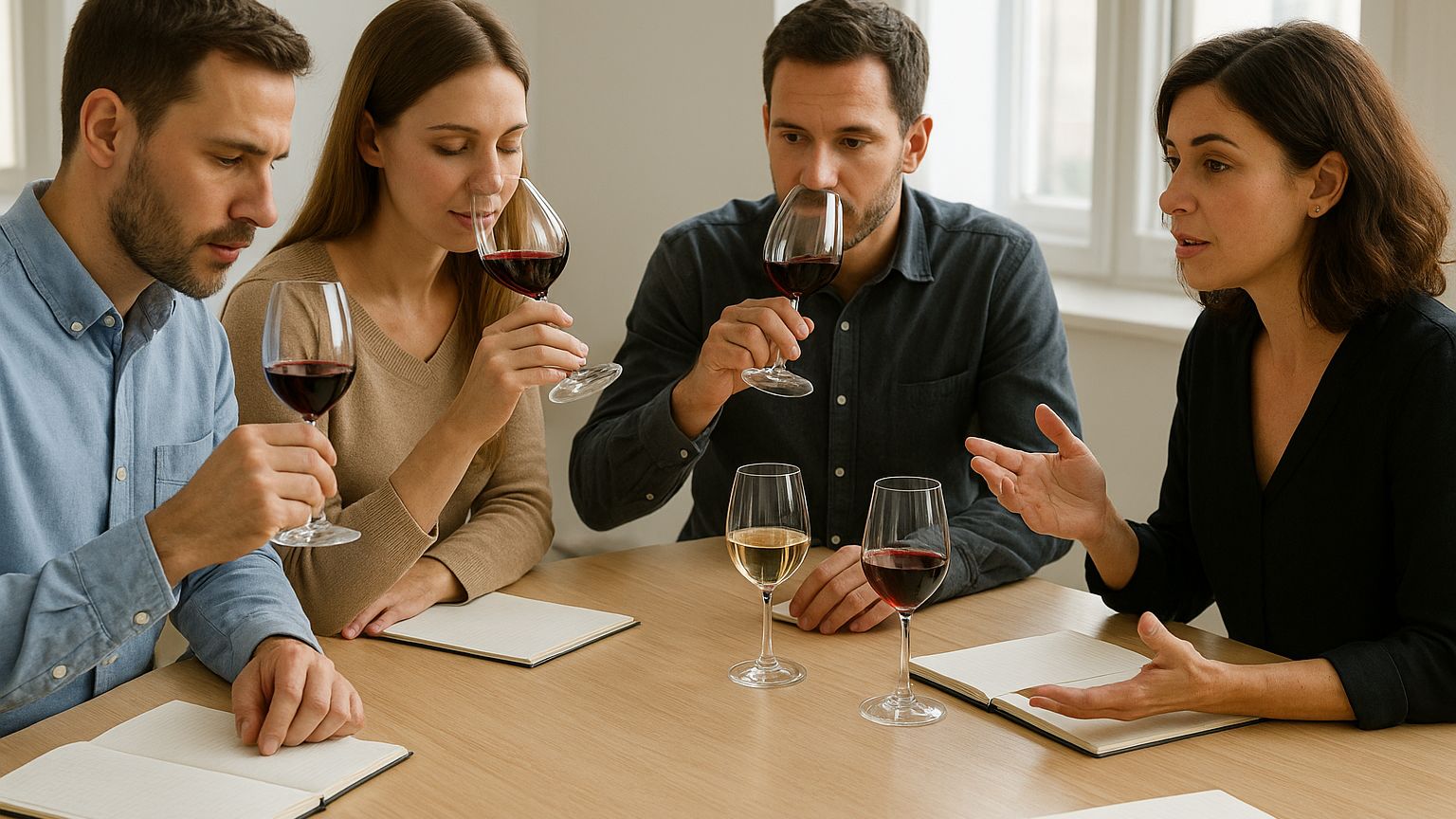
Repeated, controlled comparison turns vocabulary into instinct. WSET’s systematic framework and UC Davis sensory-training principles both lean on repetition, standardized conditions, and written descriptors rather than memory alone.
Gallup reported 58 percent of Americans drank alcohol in 2024, down from 62 percent a year earlier — fewer drinkers, but a growing share wanting to understand what they drink.
How can repeated, systematic tasting improve wine vocabulary and sensory memory?
Taste the same grape, region, or style across several sessions while holding the process constant. Record the wine without looking at the label, compare notes afterward, and reuse the same structural terms — acidity, tannin, body, alcohol, sweetness, finish. That separates a stable sensory pattern from a one-off impression.
Build each flight around one variable at a time. Blind tasting reduces label-driven expectation, but reveal the wines after you record initial notes. WSET examination practice and sensory research both use blinding to cut bias, while open-label tasting remains useful for linking a recognized style to its geography and production. If the session calls for serving rather than study, our guide to decanting for drinking rather than evaluation picks up where this method leaves off.
Which side-by-side comparisons best extend the See, Swirl, Smell, Sip, and Savor method?
The strongest next comparison contrasts wines that differ clearly in one structural dimension. A high-acid Riesling beside a fuller Chardonnay, or a low-tannin Pinot Noir beside a structured Cabernet Sauvignon, teaches more than any random flight.
| Comparison | Primary question | Five-step evidence to track |
|---|---|---|
| Cool-climate vs. warm-climate Chardonnay | How do acidity and ripeness alter balance? | Color, citrus or stone fruit, acidity, alcohol, finish |
| Pinot Noir vs. Cabernet Sauvignon | How does tannin change texture and persistence? | Color intensity, red or black fruit, grip, body, finish |
| Unoaked vs. oaked white wine | How does wood affect aroma and texture? | Fruit, toast, creaminess, body, aftertaste |
| Young vs. mature red wine | How do primary and tertiary aromas coexist? | Fresh fruit, dried notes, tannin, complexity, persistence |
For the next session, choose two or three wines, hide the labels, pour equal amounts, and complete the five-step grid before any discussion. That controlled format extends the method from a vocabulary exercise into a repeatable test of how grape, climate, production, and age shape the glass. When you’re ready to move beyond the glass itself, the parallel question of how decanting changes what you smell and taste is the natural next investigation.