Vertical vs horizontal tasting compares wines either through time or across place and production choices. A vertical wine tasting uses the same wine, usually from one producer and vineyard, across multiple vintages; a horizontal wine tasting holds the vintage broadly constant while comparing different producers, regions, vineyards, or grape varietals. WSET’s Level 3 theory materials and the Oxford Companion to Wine describe these formats as distinct methods for isolating vintage development or regional and stylistic differences.
The comparison affects what you can reasonably conclude from a wine flight. This guide examines five differences: the comparison unit, experimental control, the main discovery, tasting setup, and the practical choice between formats, before addressing faults that can weaken either design.
1. Comparison Unit: Same Producer Across Vintages vs Different Wines in One Vintage
A vertical tasting compares one producer’s wine across vintages, while a horizontal tasting compares different wines made in the same vintage or release period. WSET and the Oxford Companion to Wine use this distinction to separate time-based analysis from place-and-style analysis. The format determines which variable receives the most attention before the first glass is poured.
How does a vertical wine tasting use wine vintage as the constant variable?
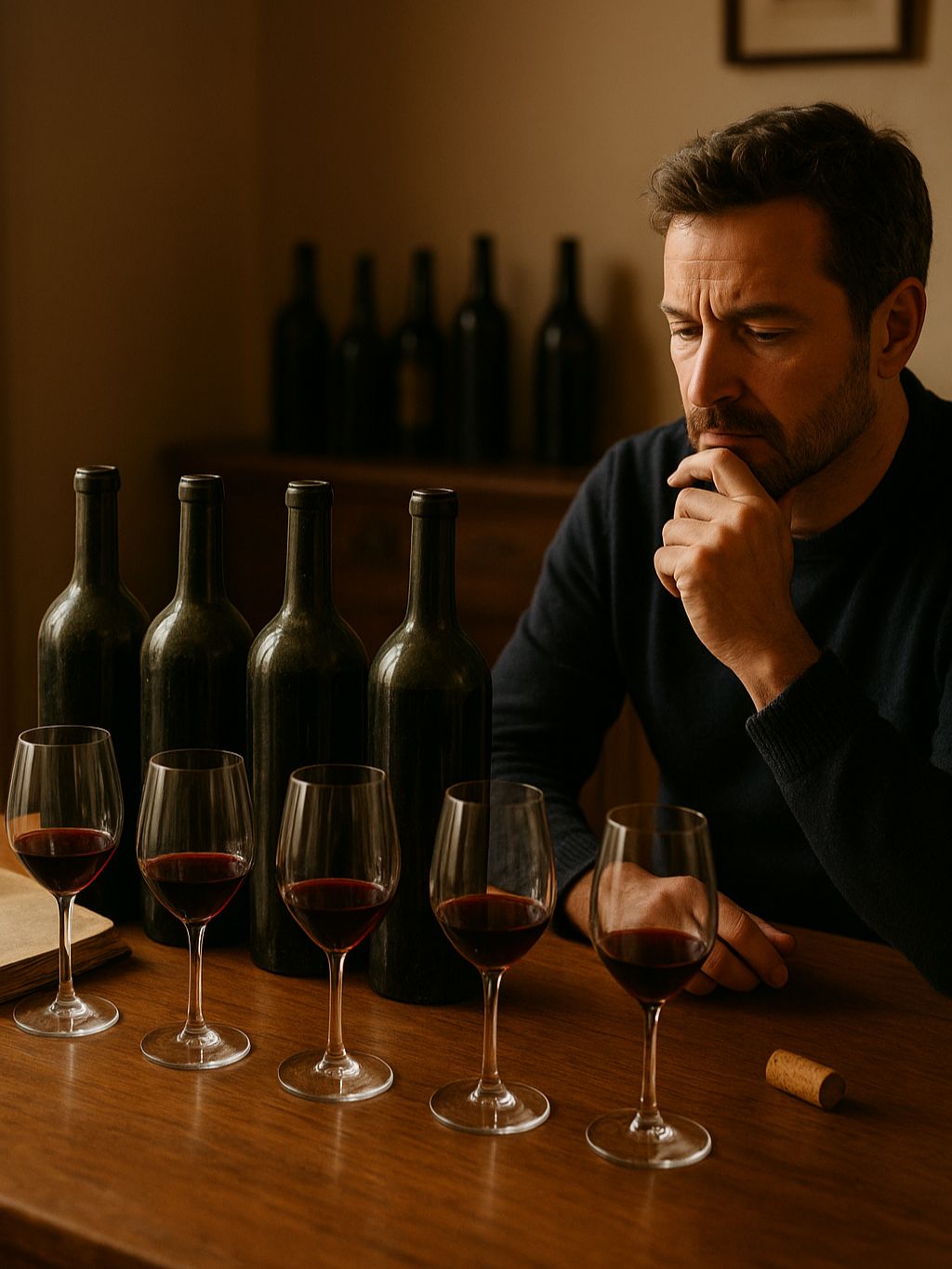
A vertical tasting keeps the wine identity as consistent as possible and changes the vintage. A classic flight might present the same château’s Cabernet-based blend from 2015, 2016, 2017, and 2018. The producer, appellation, vineyard designation, grape blend, and intended cuvée remain the reference points, while weather and the wine’s age change. WSET’s Level 3 materials and Jancis Robinson’s Oxford Companion to Wine identify this design as a way to study vintage character and bottle development.
The phrase “same wine” requires discipline. A producer may alter the grape proportions, select different vineyard parcels, change extraction, or use a different élevage regime between years. The Institute of Masters of Wine and the University of California, Davis Department of Viticulture and Enology both describe vintage composition, fruit selection, fermentation, and oak handling as variables that can shift a wine’s final profile.
How does a horizontal wine tasting hold the vintage constant while varying producer, region, vineyard, or grape varietal?
A horizontal tasting holds the harvest year or release period broadly constant and varies the wines being compared. A flight could place 2020 Chablis from four producers side by side, compare 2019 Barolo from several communes, or examine 2021 Chardonnay from different countries. WSET and the Court of Master Sommeliers frame horizontal tasting as a method for comparing regional expression, producer choices, or varietal behavior under a shared vintage context.
Horizontal does not always mean “same grape from the same region.” The organizer must define the comparison question first. Comparing 2020 Pinot Noir from Oregon, Burgundy, and Central Otago investigates regional and stylistic contrast; comparing 2020 wines from several vineyards within one appellation narrows the question toward terroir. The American Society for Enology and Viticulture and the Oxford Companion to Wine both treat site, climate, vineyard management, and cellar practice as interacting influences rather than isolated causes.
Why does the comparison unit matter when interpreting a wine flight?
The comparison unit determines whether a difference should initially be attributed to time or to production context. In a vertical, a 2016 wine may taste fresher than a 2015 wine because of growing-season conditions, bottle age, or storage history. In a horizontal, a difference between two 2020 wines may reflect soil, elevation, harvest timing, yeast, oak, or producer philosophy. WSET’s systematic tasting framework and CMS deductive tasting methodology both require tasters to separate observable evidence from conclusions about cause.
Write the comparison question at the top of the tasting sheet: “What changed across vintages?” for a vertical, or “What changes across producers and sites?” for a horizontal. That single sentence prevents a common analytical error—using a vertical to make a broad terroir claim or using a horizontal to make a confident statement about aging.
2. Experimental Control: Producer and Vineyard Consistency vs Regional Diversity
A vertical tasting controls producer identity and often vineyard identity, whereas a horizontal tasting deliberately introduces regional, viticultural, and stylistic diversity. The two formats resemble different experiments: one narrows the field to observe change over time, and the other broadens the field to compare responses within a shared period. WSET, the Institute of Masters of Wine, and UC Davis enology research all support this variable-based approach.
Which factors should remain consistent in a vertical wine tasting?
A useful vertical keeps the cuvée, producer, vineyard designation, bottle format, and service conditions consistent wherever the available bottles allow it. The vintage should be the principal changing variable, not bottle size or a switch between a producer’s entry-level and flagship wine. The Court of Master Sommeliers and WSET service guidance also support consistent glassware, serving temperature, and pour size because service variation changes the sensory comparison.
- Wine identity: use the same labeled cuvée or vineyard bottling.
- Producer: confirm that the wine comes from the same estate or négociant program.
- Format: compare standard bottles with standard bottles when possible.
- Service: use identical glasses and controlled temperatures.
- Documentation: record vintage, alcohol, blend, closure, and provenance before tasting.
How do vineyard practices, producer philosophy, and cellar decisions shape a vertical comparison?
Producer decisions can moderate or amplify the effect of vintage conditions. Harvest date, crop level, irrigation, sorting, fermentation vessel, maceration, barrel proportion, sulfur management, and bottling timing all influence the finished wine. The American Society for Enology and Viticulture and UC Davis identify these choices as measurable contributors to aroma, structure, stability, and longevity.
That fact creates a productive tension. A vertical does not reveal “the vintage” in isolation; it reveals how one producer translated each vintage into wine. If the estate changes from large-format oak to stainless steel, or shifts its harvest date substantially, the flight becomes a study of both climate and house style. Note such changes rather than treating them as noise. The Institute of Masters of Wine recommends consulting technical sheets and producer records when a comparative tasting demands historical precision.
Why does a horizontal tasting intentionally introduce more variation between wines?
A horizontal tasting needs variation because its purpose is to expose differences among places, producers, vineyards, or grape varietals. Keeping the vintage similar reduces one source of variation, allowing the taster to focus on geography and winemaking. WSET and the Oxford Companion to Wine describe this as a practical way to examine terroir, although neither source treats terroir as a single measurable ingredient.
A well-designed horizontal sets boundaries before adding diversity. Four 2020 Premier Cru Chablis wines answer a different question from four 2020 Chardonnay wines made on three continents. The first emphasizes site and producer within one regional framework; the second introduces climate, regulation, grape material, and market style. Define the boundaries, then record the variables that fall outside them.
3. The Main Discovery: Wine Aging and Climate Variation vs Terroir and Winemaking Style
🎯
Related Offering
How to Taste Wine Like a Sommelier: The 5-Step Method
Learn a structured tasting method to evaluate vintage, regional, stylistic, and production differences with greater confidence.
Vertical tastings are strongest for studying maturation and vintage variation, while horizontal tastings are strongest for studying terroir, regional identity, and winemaking style. Neither format produces a perfect laboratory result because wine changes through interacting biological, chemical, and human factors. WSET, UC Davis, and the Oxford Companion to Wine all present wine character as the result of those combined influences.
What can a vertical tasting reveal about vintage conditions, climate, aging, and long-term wine development?
A vertical can show how acidity, tannin, fruit character, alcohol impression, oak integration, and tertiary aromas evolve across harvest years. Cooler or warmer growing seasons often affect ripeness and acid balance, while bottle age changes the relationship among fruit, structure, and developed aromas. The European Geosciences Union’s wine-climate research and the International Organisation of Vine and Wine’s climate publications connect temperature and seasonal conditions with grape ripening, while WSET explains how wine structure changes during maturation.
The flight may reveal a producer’s response to difficult conditions more clearly than a single bottle can. A later harvest could create a fuller, higher-alcohol wine; stricter selection might preserve balance in a challenging year. Those interpretations require vintage reports and technical data because tasting alone cannot establish rainfall, temperature, or harvest dates. Use the sensory evidence to form a question, then test it against producer records and regional vintage assessments.
What can a horizontal tasting reveal about terroir, geography, wine region, grape varietal, and producer decisions?
A horizontal tasting reveals how wines made in a shared period diverge according to site, climate, grape material, and cellar choices. Soil drainage, slope, elevation, exposure, water availability, vineyard temperature, and local winemaking traditions can all influence the wine. Research published by the American Society for Enology and Viticulture and the University of Burgundy shows that site-related effects interact with climate and vineyard management rather than operating as a simple “soil equals flavor” formula.
Producer style remains visible even when the wines come from the same region. One estate may emphasize early picking and restrained oak; another may favor later ripeness and extended élevage. The Court of Master Sommeliers and the Institute of Masters of Wine advise tasters to distinguish structural observations—acid, tannin, alcohol, body, and finish—from stylistic judgments such as “traditional” or “modern.”
How should tasters separate vintage effects from bottle age and winemaking changes?
Tasters should separate vintage effect, chronological age, storage history, and production change rather than assigning every difference to climate. In a vertical, the oldest wine has both a different vintage and more time in bottle; that overlap prevents a clean causal conclusion. The Australian Wine Research Institute and UC Davis identify oxygen exposure, closure performance, temperature, and wine composition as factors that influence aging trajectories.
| Observed difference | Possible explanation | Evidence to check |
|---|---|---|
| Lower fruit and softer tannin | Bottle development or oxidation | Fill level, closure, storage, color, provenance |
| Higher alcohol impression | Riper vintage or later harvest | Technical sheet, harvest date, alcohol level |
| More oak aroma | Changed barrel program | Producer notes, oak percentage, élevage duration |
| Uneven freshness | Vintage conditions or bottle variation | Second bottle, vintage report, storage history |
4. Tasting Setup: How Serving Order, Glassware, and Flight Design Change the Comparison
Serving order, glassware, temperature, and bottle handling determine whether tasters compare the wines or merely react to service differences. WSET service standards and the Court of Master Sommeliers’ tasting guidance both treat controlled presentation as part of sound evaluation. A sophisticated wine flight still fails if the first wine is warm, the oldest bottle is exhausted, or one sample receives a different glass.
How should vertical and horizontal wines be arranged and served?
Serve wines in an order that protects the palate and makes the intended contrast visible. A practical default moves from lighter to fuller, lower to higher alcohol, less aromatic to more aromatic, and younger to older when the wines share a style. WSET recommends considering body, sweetness, acidity, tannin, and intensity when planning sequence; CMS service practice also places lighter and less powerful wines before heavier examples.
- Confirm the wines and conceal labels if blind assessment is part of the exercise.
- Pour equal amounts into identical glasses, keeping the serving temperature consistent.
- Place the wines in tasting order, not necessarily chronological order, if power or sweetness demands another sequence.
- Retaste after all wines have been poured because air exposure may alter the ranking.
When should older bottles be opened, decanted, or served before younger wines?
Older bottles require assessment rather than an automatic decanting rule. WSET and the Napa Valley Vintners’ service guidance distinguish sediment removal from aeration: an older red may need careful decanting to separate sediment, but extended exposure to oxygen may diminish a fragile wine. Young, tannic wines often tolerate or benefit from more air, while mature wines can change rapidly.
Open a sound older bottle shortly before service, taste a small sample, and decide whether the wine needs sediment removal or merely gentle pouring. Serve a delicate mature wine before a powerful young wine if the sequence would otherwise flatten its aromas. Keep the bottle available for retasting; the bottle’s development after opening supplies additional evidence about its condition.
How do one-glass-per-wine, serving temperature, palate cleansing, and structured notes improve side-by-side tasting?
One glass per wine improves side-by-side comparison by preventing aroma carryover and preserving each sample’s identity. WSET tasting guidance emphasizes clean, odor-free glassware, while the Court of Master Sommeliers uses consistent glassware and controlled service to support sensory assessment. If glass numbers are limited, rinse with the next wine rather than tap water, which introduces dilution.
Use the producer’s recommended temperature as the starting point, then apply WSET’s service ranges: roughly 7–10°C for light white wines, 10–13°C for fuller white wines, and 13–18°C for red wines. Record appearance, nose, palate, structure, finish, and development separately. Water and plain bread help reset the palate; strongly flavored food changes the comparison and belongs in a separate food-pairing exercise.
5. Choosing the Right Format: Learning Goals, Budget, and Bottle Availability
🎓
Related Offering
WSET vs CMS vs FSS: Which Sommelier Certification Should You Choose in Bangkok in 2026?
Compare the major sommelier certification pathways and find the training framework best suited to your wine education goals.
Choose a horizontal tasting for breadth and a vertical tasting for depth. A horizontal introduces several reference points in one session, while a vertical demands repeated attention to one producer’s identity across time. WSET and CMS educational tasting methods support matching the flight design to the learning objective rather than treating one format as universally superior.
When should a beginner choose a horizontal wine tasting to learn about regions, producers, or grape varietals?
Beginners should choose a horizontal when they need clear contrasts among regions, producers, or grape varietals. Five wines from one vintage make differences easier to discuss because bottle age does not dominate the comparison. A flight of Sauvignon Blanc from Marlborough, Sancerre, and California, for example, creates a direct conversation about climate, regional convention, and producer style.
Keep the first horizontal narrow: one grape, one vintage, and three to five wines is more informative than a global assortment of unrelated bottles. The Court of Master Sommeliers and WSET both use structured comparative tasting to train recognition of acidity, tannin, body, alcohol, and aroma intensity. Begin with one variable that the group can name and measure.
When is a vertical tasting better for understanding wine aging and vintage variation?
A vertical is better when the learning goal concerns maturity, vintage reputation, cellar development, or a producer’s consistency. Comparing several years of one Rioja Gran Reserva, Barolo, or Bordeaux estate shows how fruit, tannin, acidity, oak, and tertiary character interact over time. WSET and the Institute of Masters of Wine both treat bottle age and vintage conditions as central components of advanced wine analysis.
Verticals suit smaller groups that can spend time with each bottle. A four-vintage flight may reveal more about a producer’s choices than a single prestigious bottle, but the bottles should share provenance and cuvée identity. If the group lacks context about the region, pair the flight with vintage charts and producer data rather than relying on memory.
Which format is more practical when budget, rarity, and bottle availability limit the tasting?
A horizontal is usually more practical when older vintages are rare or expensive, while a vertical becomes practical when a producer releases multiple years at accessible prices. Horizontal flights can use current-release bottles from several producers, avoiding the premium attached to mature stock. A vertical may require auction purchases, specialist merchants, or cellar holdings, and the oldest bottle may carry uncertain provenance.
Budget also changes the risk profile. One faulty bottle in a four-wine horizontal affects one producer; one faulty bottle in a four-vintage vertical may remove a key historical reference point. Use half-bottles or small pours where legal and appropriate, and allocate money to sound provenance before adding another bottle.
Comparison Pitfalls: Cork Variation, Storage History, Bottle Age, and Inconsistent Production
⭐
Related Offering
Advanced Sommelier Course Bangkok 2026: The 3-Day Certified Program That Takes You to Professional Level
Build advanced blind-tasting, analytical, and professional service skills through an intensive certified sommelier program.
Faults and uncontrolled variables can make a vertical or horizontal tasting support weaker conclusions than its polished format suggests. Wine faults research from the Australian Wine Research Institute and UC Davis identifies cork taint, oxidation, reduction, volatile acidity, and closure variation as conditions that can alter aroma and structure independently of vintage, region, or producer.
How can poor provenance or different storage conditions distort a vertical tasting?
Poor provenance can make storage history look like vintage character. Heat exposure accelerates chemical reactions, temperature fluctuation stresses closures and bottles, and low fill levels may signal evaporation or leakage. The Wine & Spirit Education Trust and the Australian Wine Research Institute both connect storage conditions and oxygen exposure with changes in freshness, color, aroma, and stability.
Inspect capsule condition, fill level, label history, closure, and sediment before tasting. A vertical that combines a professionally stored 2010 bottle with an unknown-source 2010 bottle does not provide equal evidence. Mark uncertain bottles in the notes and avoid using them as the decisive example for a vintage claim.
What should tasters do when cork taint, bottle variation, oxidation, or sediment affects one wine?
Isolate the affected bottle, describe the fault, and replace the sample before drawing a comparative conclusion. The Australian Wine Research Institute identifies 2,4,6-trichloroanisole as a major compound associated with cork taint, while UC Davis sensory research distinguishes musty taint from oxidation and other wine faults. A musty, damp-cardboard aroma, bruised-apple character, browning, or unusually flat palate should trigger inspection rather than immediate judgment.
- Cork taint: retain the bottle and compare a second bottle if available.
- Oxidation: check fill level, closure, color, and storage before interpreting age.
- Sediment: decant carefully, but do not confuse harmless sediment with a fault.
- Bottle variation: taste another bottle or label the result as bottle-specific.
When is a vertical or horizontal comparison too uncontrolled to support a confident conclusion?
A comparison becomes too uncontrolled when multiple major variables change at once or when one or more bottles have uncertain condition. A flight mixing grape varietals, vintages, bottle ages, sweetness levels, and service temperatures cannot isolate a meaningful cause. WSET’s systematic approach and CMS deductive tasting method both require tasters to state observations before making conclusions and to recognize the limits of the sample.
Use cautious language when the design is weak: “this bottle showed” is more defensible than “the region produces.” The next level of rigor is a repeated flight—two bottles per wine, identical service, documented provenance, and a prewritten question. For advanced study, the logical extension is a blind comparative tasting with controlled variables, followed by an open-label discussion of producer records and vintage data.