Wine cellar humidity is the water vapor held in your storage air, reported as relative humidity (RH) — the moisture present as a percentage of what the air can hold at the cellar’s temperature. We hold cork-sealed bottles at 55–59°F (12–15°C) and about 60% RH, inside a working band of 50–70%. Readings that sit above 75–80% damage labels, breed mold, and corrode fittings long before they harm sealed wine.
The global wine cellar market is projected to climb from USD 3.4 billion in 2025 to USD 5.5 billion by 2035 at a 5.1% CAGR, according to Future Market Insights — and a large share of that spending corrects humidity after the damage starts. This guide sets the target numbers, shows what excess moisture actually does, walks through diagnosis and equipment choice, then closes with a 72-hour action plan built for tropical cellars.
Ideal Wine Cellar Humidity and Temperature
Set a wine cellar at 55–59°F (12–15°C) with relative humidity near 60%, and you hold the two conditions that decide how wine ages. Wine Cellar Authority’s 2026 guidance places the preservation range at 50–70% RH with 60% as the central target, while Wine Guardian calls 60% ideal and 50–70% acceptable in its humidity guide. Both converge on one operating band: 60–70% RH, with anything above 75% demanding action.
Consistency matters more than the exact number. A cork that cycles between damp and dry expands and contracts, and each cycle loosens the seal a little further — which is why we monitor the swing, not just the average. Screw-capped bottles ignore humidity entirely, because the mechanical seal is airtight, so humidity control protects cork-sealed wines and the materials around them.
| Wine type | Storage temperature | Humidity | Risk to manage |
|---|---|---|---|
| General long-term | 55–59°F (12–15°C) | 60% RH (50–70%) | Temperature cycling; dry corks below 50% |
| Red wine | 57–59°F (14–15°C) | 50–70% RH | Accelerated aging above 68°F |
| White wine | 45–50°F (7–10°C) | 50–70% RH | Cork drying in very low humidity |
| Sparkling | 39–45°F (4–7°C) | 50–70% RH | UV damage; cork failure under cycling |
Storage and serving are separate jobs — keep the cellar stable, then chill or warm bottles just before pouring. Choosing the bottle matters too, so compare red, white, and rosé by taste and pairing before your next dinner.
Wine aging roughly doubles with every 10°C (18°F) rise in temperature, a rule of thumb documented in ScienceDirect’s wine aging reference. A cellar left at 75°F can age wine several times faster than one held at 57°F.
What High Humidity Does to Wine and Cellar Materials
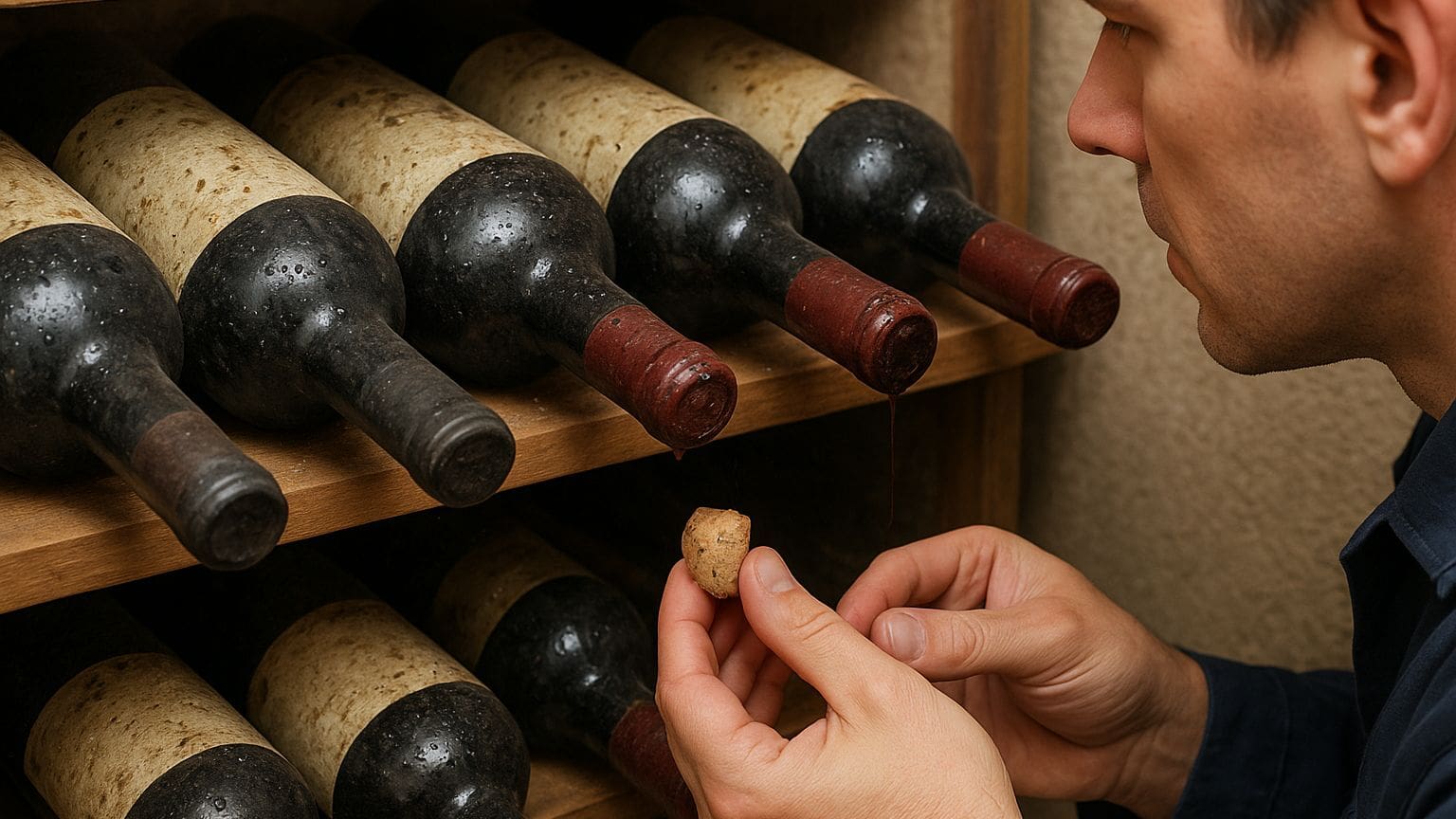
High humidity attacks the packaging and the room before it touches the wine — labels, corks, wood, cardboard, and metal fail in that order. Paper turns wavy and lifts at the edges, cartons soften and collapse, racks swell and hold moisture, and capsules corrode. The wine itself, sealed behind cork and glass, usually survives — but excess moisture destroys resale value through label and capsule damage.
Here is the tension most guides skip: a wine cellar deliberately runs above the mold guideline that governs every other room. The US EPA and ASHRAE direct building owners to keep indoor humidity below 60% to prevent mold, yet your cellar operates at 60–70% by design. That overlap is exactly why sealed construction, clean dry surfaces, and stable readings matter more in a wine room than anywhere else in the house.
Corks, Labels, and the Mold Threshold
A cork kept below 50% RH dries, shrinks, and admits oxygen faster than intended; a cork kept above 70% RH can harbor surface mold. Label damage is the canary: wavy, stained, or detached paper means sustained moisture, even when no mold is visible yet. Fuzzy white, gray, or black growth on labels, wood, or walls is an early warning sign — remove the source before cleaning, or the growth returns.
Why Heating the Cellar Backfires
Warming a damp room lowers the displayed RH without removing a gram of water. Heat the same air from 55°F to 68°F and its reading can drop from the 80s into the mid-50s — while the moisture stays put and every aging reaction speeds up. Heating fools the hygrometer, not the cellar. Would you rather dry the room or just chase a prettier number? Extract the water first, then let temperature settle.
The US EPA’s mold guidance and ASHRAE both target relative humidity below 60% to suppress mold growth — yet a wine cellar’s 60–70% operating band sits above that line, which is why surface moisture control does the heavy lifting in any storage room.
Diagnose the Cause Before Buying Equipment
Before you spend on a dehumidifier, identify the moisture source — a reading above 80% is a symptom, and the fix differs for infiltration, condensation, a leak, or a cooling fault. One damp pipe is not the same disease as every rack wet at once. Run a short investigation first; equipment comes second.
Run a 72-Hour Humidity Investigation
Log readings every 15–30 minutes for three days with the door closed. Ask one diagnostic question: does RH rise after every door opening, or does it climb back overnight with the door sealed? The first pattern points to humid outdoor air infiltrating through gaps; the second points to an internal source — a leak, a blocked drain, or an equipment fault.
Condensation and the Dew Point Math
Condensation appears when a surface drops below the dew point of the air around it. Any bottle, wall, or coil colder than the dew point will bead with water. In Bangkok, air near 30°C (86°F) and 75% RH carries enough vapor to condense on surfaces cooled to 12–14°C, so compare a wet surface’s temperature with room air using an infrared thermometer.
At 55°F and 70% RH, the dew point is just over 46°F (8°C) — every surface in the cellar colder than that threshold condenses water out of the air, as CellarCool’s dew point guide explains.
Mold, Musty Odors, and Deteriorating Wood
Inspect behind racks, under cases, around door frames, and beside condensate drains. Musty odor is airborne evidence of a moisture colony, and a fan only stirs it around — circulation moves air, it does not extract water. Treat the moisture source first, then clean small areas with protection, and flag porous material for specialist work if the smell returns after seven dry days.
Wet Labels vs. a Leaking Bottle
Dampness spread across many bottles signals room humidity; a sticky trail from one neck signals a leaking closure. Check the fill level and capsule before you clean anything. Dry labels with gentle airflow, never a hairdryer, and photograph a leaking bottle before isolating it.
| Symptom | Likely cause | First action |
|---|---|---|
| RH above 80% | Moisture entry, leak, or faulty sensor | Confirm with a second hygrometer, then trace vapor paths |
| Water under the cooling unit | Blocked drain, failed pump, or poor slope | Protect bottles; service the condensate route |
| Wet bottles after the door opens | Warm humid air hitting cold glass | Repair the gasket; limit opening |
| Mold behind racks | Stagnant air plus porous material | Move bottles, inspect wall and floor |
| One stained capsule or low fill | Closure failure | Isolate and document the bottle |
| RH below 50% | Over-drying or dry airflow | Ease drying back toward 60–70% |
How to Choose Dehumidification Equipment for a Cold Cellar
A dehumidifier removes water, a hygrometer measures it, and a cooling unit transfers heat while shedding condensate — and none of them repairs an open vapor path or a blocked drain. Choose equipment to match the cellar’s actual operating temperature, not its square footage.
Compressor vs. Desiccant Below 60°F
Standard compressor dehumidifiers are rated for warm rooms and lose efficiency below about 65°F (18°C); many struggle or frost near 55°F. Desiccant units use a silica rotor that adsorbs moisture at any temperature, working reliably down to around 33°F (1°C). Meaco’s buying guide and EcoAir both recommend desiccant once a space falls below 15°C (59°F) — which describes nearly every wine cellar.
Why Pint Ratings Mislead
A unit labeled 30 pints per day is measured at 80°F and 60% RH — conditions no cellar matches. That same machine may pull only 10–12 pints at 55°F. Oversize by roughly two to three times your apparent need, or choose a model whose low-temperature extraction is published rather than inferred.
A compressor unit rated 30 pints per day at 80°F can drop to 10–12 pints at 55°F, the reason Indoor Humidity’s dehumidifier guide urges buyers to demand low-temperature performance data before purchasing.
Placement and the Salt Calibration Test
Place two sensors at bottle height, away from doors, supply outlets, and exterior walls. To verify a sensor, run the saturated-salt test: wet table salt (sodium chloride) in a sealed container produces about 75% RH, a fixed point documented in Vaisala’s HMK15 calibration guide. Compare your instruments against that benchmark instead of trusting a single display.
When the Cooling Unit Can Handle Humidity
A cooling coil strips moisture whenever moist air crosses a cold evaporator and condensate drains away — that is latent cooling. It removes almost nothing when the room already sits at setpoint or when moisture enters faster than the coil condenses it. An oversized unit short-cycles; an undersized one runs continuously while failing to hold temperature.
Drainage, Humidification, and the Competitor Blind Spot
Most ranking guides stop at “buy a dehumidifier.” Wine Cellar Authority’s quick-fix page leans on product links and a US cooling catalog, while Architecture Intérieure du Vin’s dehumidifying guide names real causes but offers no hard numbers and no tropical-climate treatment. Neither tells a Bangkok owner that an unsealed concrete wall defeats any machine — the point we address next. Use continuous drainage so a full reservoir cannot halt drying overnight, and add humidification only when verified readings sit below 50% after airflow is fixed.
Cellar Construction: Vapor Barriers and Ventilation
A stable cellar is a sealed envelope first and a climate machine second. Continuous insulation with a vapor barrier on the warm side stops moisture before it enters, which matters more in Bangkok than any single device.
Seal Vapor Paths Before Adding Capacity
Caulk door gaps, floor joints, cable routes, and plumbing openings before buying a bigger machine. Wine Guardian’s build guidance calls for a vapor barrier — at least 4–6 mil polyethylene — installed on the warm (outside) side of the insulation, with seams overlapped and taped. Never seal an actively wet wall until you find the water source; trapped moisture rots framing and insulation.
Controlled Ventilation Without Importing Bangkok Air
An open grille exchanges stale air for hot, moisture-laden outdoor air and pushes the load onto your cooling unit. Mechanical exhaust with filtered, conditioned make-up air beats an open vent. Keep airflow gentle — strong drafts aimed at corks and labels dry them locally even when the room reads humid.
Light, Odor, and Rack Materials
Keep ultraviolet light away from Champagne, white Burgundy, and delicate reds; fluorescent tubes emit UV that degrades wine. Store bottles away from solvents, paint, and strong cardboard, which taint wine through the cork, and choose rack materials that shed moisture rather than absorb it.
Managing Wine Cellar Humidity in Bangkok
Bangkok cellars fight a worse enemy than most guides acknowledge. Average monthly outdoor humidity runs from 60% in December to 81% in September and October, according to Climate-Data.org, and warm monsoon air carries enormous moisture into any gap. A design that idles in a dry climate runs continuously here.
That is why we size for latent heat — the energy spent condensing water vapor — alongside sensible heat. Cooling exhaust must discharge into a ventilated area, dehumidifiers need continuous drainage, and every penetration must be sealed. Air-conditioning the adjacent room does nothing for moisture migrating through concrete.
We have watched Bangkok cellars that held a steady 54°F in the low 70s jump into the 90s RH after an evaporator replacement, simply because the new coil ran warmer and the fan speed changed. The fix was equipment diagnosis and a moisture-load calculation, not a bigger dehumidifier. Check your service history before your shopping cart.
In September and October, Bangkok’s average outdoor humidity reaches 81% — a Climate-Data.org figure that means a 13°C cellar pulls moisture out of tropical air every time a door opens or a seal fails.
Wine Cellar vs. Wine Refrigerator
A wine cellar is a room you condition; a wine refrigerator is an insulated cabinet that conditions itself. A fridge controls temperature precisely but rarely holds a selectable 60–70% RH band — humidity is often passive or incidental.
| Feature | Dedicated cellar | Wine refrigerator |
|---|---|---|
| Temperature control | Depends on insulation and sizing | Precise inside the cabinet |
| Humidity control | Dedicated dehumidifier or humidifier | Often passive or incidental |
| Moisture risk | Doors, walls, drains, condensation | Defrost cycles, dry airflow, cabinet condensate |
| Maintenance | Envelope, cooling, drainage, sensors | Clearance, filter, drain, gasket, sensor |
Store bottles horizontally in both, keep them off direct cold-air outlets, and never place an open water bowl inside a cabinet. A refrigerator cannot solve mold or leakage in the surrounding room — it only protects what is inside it.
72-Hour High-Humidity Action Plan
First 24 Hours
- Confirm the reading with a second hygrometer placed at bottle height.
- Stop obvious moisture entry: repair the door gasket, cap open drains, close vents.
- Check the cooling unit’s condensate route for blockages and standing water.
- Remove or isolate visibly wet cardboard and any leaking bottles.
Next Seven Days
- Review 15–30-minute logger data for cycling, peaks, and overnight recovery.
- Inspect vapor barriers, penetrations, floor edges, and exhaust clearance.
- Hold storage near 55–59°F and keep RH from falling below 50%.
- Watch for dry surfaces, no returning odor, and stable readings.
When to Call a Professional
Call a refrigeration engineer when RH stays above 80%, condensation returns, or water reaches electrical components after 24–72 hours of source isolation. A building specialist should inspect insulation, vapor barriers, and drainage when moisture migrates through walls or the odor persists after a week of dry readings. Once the room recovers, serving is a different skill — our guide to decanting wine without ruining it walks through what changes once the bottle leaves the rack.
Wine Cellar Humidity FAQs
Is 80% humidity too high for a wine cellar?
Persistent 80% RH is too high, because it raises the risk of mold, damp labels, and corrosion. One brief spike does not condemn the wine — confirm the reading, find the source, and bring conditions gradually toward 60%.
Will high humidity ruin wine inside the bottle?
High room humidity rarely ruins properly sealed wine, but leakage, condensation, damaged closures, and prolonged poor storage can. Check fill level, capsule staining, and cork movement before assuming the wine is compromised.
Can I use a normal household dehumidifier at 55°F?
Some compressor units lose performance or frost near 55°F (13°C). Check the manufacturer’s low-temperature range and extraction rate at that temperature, and prefer continuous drainage over warm-room capacity.
Should I leave the cellar door open?
Only as a short diagnostic step when adjoining air is measurably cooler and drier. In Bangkok an open door usually admits warmer, wetter air and raises condensation risk — a controlled, conditioned air path works better.
What humidity protects corks without causing mold?
Around 60% RH, within a practical 50–70% band, balances cork moisture against mold risk. Cork condition also depends on closure quality, bottle position, and airflow, so room RH cannot compensate for a defective cork.
How often should a wine cellar be checked?
During a humidity event, log every 15–30 minutes and inspect daily. After stabilization, review weekly highs and lows, clean condensate routes on the manufacturer’s schedule, and compare sensors periodically — a sudden shift after a cooling-system change points to equipment diagnosis, not a bigger dehumidifier.
Once your cellar holds steady near 60% RH, the question shifts from the room to the glass. Serving temperature is not storage temperature, and a wine’s documented condition is now part of its value — Michelin’s first-ever wine estate award shows how closely provenance and label condition are now scrutinized.