High humidity in a wine cellar needs a measured response. Persistent moisture damages labels, encourages mold, corrodes fittings, weakens cardboard and wood, and creates condensation around cold bottles, walls, and cooling equipment. A reliable cellar protects wine through stable temperature, controlled relative humidity, low light, clean air, and gentle circulation—not through cool temperatures alone.
Use 55–59°F (12–15°C) for long-term storage and aim for approximately 60% relative humidity. A practical operating band is 50–70% RH. Wine Cellar Authority guidance published in 2026 recommends roughly 50–70% RH, while Wine Guardian Dealer’s 2026 guide describes a broader 55–75% range and emphasizes relatively constant conditions between 60% and 70%. Wine Cellar Authority’s 2026 preservation guidance supports the 50–70% operating range, while brief excursions outside it call for monitoring rather than panic.
Fast rule: Do not “fix” high humidity by heating the cellar. Heating lowers the displayed relative humidity while leaving the water in the room and accelerating wine aging. Remove moisture at the source and keep the storage temperature steady.
Quick Answer: How to Fix High Humidity in a Wine Cellar
Confirm the reading, stop moisture entry, inspect the cooling unit’s condensate system, improve controlled air movement, and install low-temperature-rated dehumidification when required. Set the cellar near 55–59°F (12–15°C) and target approximately 60% RH. Verify the result over 72 hours rather than trusting the first dry afternoon.
- Measure: compare two hygrometers at bottle height for 24 hours.
- Inspect: check door seals, wall penetrations, floor edges, plumbing, drains, and condensate lines.
- Protect: isolate leaking bottles, damp cases, and mold-affected materials.
- Dry: use a dehumidifier rated for the cellar’s actual operating temperature.
- Verify: record RH peaks, lows, temperature, door openings, and equipment cycling for seven days.
A portable household dehumidifier may remove water in a warm room but perform poorly near 55°F (13°C). Check its extraction rating at the cellar’s real temperature, not only its headline capacity. A sealed underground cellar, an uninsulated room, or a Bangkok installation may need a dedicated low-temperature unit or a professionally designed climate-control system. The 2026 Wine Cellar Cooling protection guidance also treats cooling performance, insulation, condensate management, and moisture control as connected parts of wine storage.
What High Humidity Does to Wine Bottles and Cellar Materials
Excess humidity usually harms packaging and the cellar before it directly spoils sealed wine. Paper labels become wavy, stained, or detached; cardboard cases soften; wooden racks retain moisture; metal hardware corrodes; and porous masonry can hold a musty odor after the air dries. Persistent RH above 75–80% creates favorable conditions for surface mold, especially behind racks or beneath cases. Wine Guardian Dealer’s 2026 humidity guidance identifies label protection, cork integrity, mold prevention, and stable storage conditions as linked environmental concerns.
Mold on a wine label often signals sustained moisture rather than immediate wine damage. Fuzzy white, gray, or black growth on labels, wooden racks, walls, or counters acts as an early warning sign. Remove the source before cleaning, or the growth will return.
- Labels: peeling adhesive, staining, mildew spots, bubbling, and softened paper.
- Corks and capsules: condensation, staining, seepage, or a pushed cork.
- Racks and cases: mold growth, swelling, warping, and persistent odor.
- Equipment: corrosion, blocked drains, electrical risk, and inefficient operation.
High room humidity does not automatically ruin every cork-sealed bottle. Cork performance also depends on closure quality, bottle age, storage temperature, bottle position, leakage, and local airflow. A dry cork, however, can allow more oxygen into the bottle than intended and prematurely age or spoil the wine. The practical 50–70% RH range described by 2026 wine-storage guidance helps balance cork protection against mold and material damage.
Dry, Crumbling, or Shrunken Corks
Corks that feel unusually dry, crumble during removal, or appear shrunken within the neck suggest extended low humidity, direct cold airflow, upright storage, or an aging closure. A dry cork lets in more oxygen than intended and can prematurely age the wine. Do not respond by pushing humidity above 70% without confirming the room reading.
Keep bottles on their side when the closure and rack design support horizontal storage. Inspect the fill level, capsule, cork fragments, and aroma after opening. A damaged cork does not prove that high cellar humidity caused the problem; look for the longer environmental pattern.
Peeling Labels Without Visible Mold
Peeling, bubbling, or discolored labels may indicate humidity swings rather than one sustained reading. A consistent 65% RH generally protects paper better than a room that repeatedly moves between very dry and very damp conditions. Humidity stability matters as much as the number on the display.
Photograph valuable labels before attempting repairs. Let damp bottles dry through gentle room air, separate touching bottles, and avoid hairdryers, heaters, direct sun, and aggressive wiping. Rapid heat can loosen adhesive and create a sudden temperature change around the wine.
Ideal Wine Cellar Temperature and Humidity
Use 55–59°F (12–15°C) for long-term storage, with approximately 60% RH as the central target. Wine Guardian Dealer’s 2026 humidity guide describes a 55–75% range and recommends keeping conditions relatively constant between 60% and 70%. Wine Cellar Authority guidance published in 2026 gives a 50–70% RH preservation range. These recommendations overlap around 60–70%, making that band a practical operating target rather than a rigid pass/fail threshold.
| Condition | Practical target | Main risk to watch |
|---|---|---|
| Long-term wine storage | 55–59°F (12–15°C), around 60% RH | Temperature cycling and closure deterioration |
| Preferred operating band | 60–70% RH | Mold at the upper end; dry corks below the lower end |
| Broader short-term tolerance | 50–80% RH briefly | Repeated extremes and unstable conditions |
| Red, white, and sparkling wine | Store consistently; chill before serving | Condensation during transfers |
Storage and serving temperatures perform different jobs. Keep the cellar stable rather than lowering the entire room to serving temperature. When a collection includes rare Burgundy, Champagne, or other sensitive bottles, environmental consistency protects both the wine and its presentation. The rise of specialist recognition such as Michelin Grapes also reflects how provenance, estate quality, and presentation increasingly shape wine culture.
Diagnose the Cause Before Buying Equipment
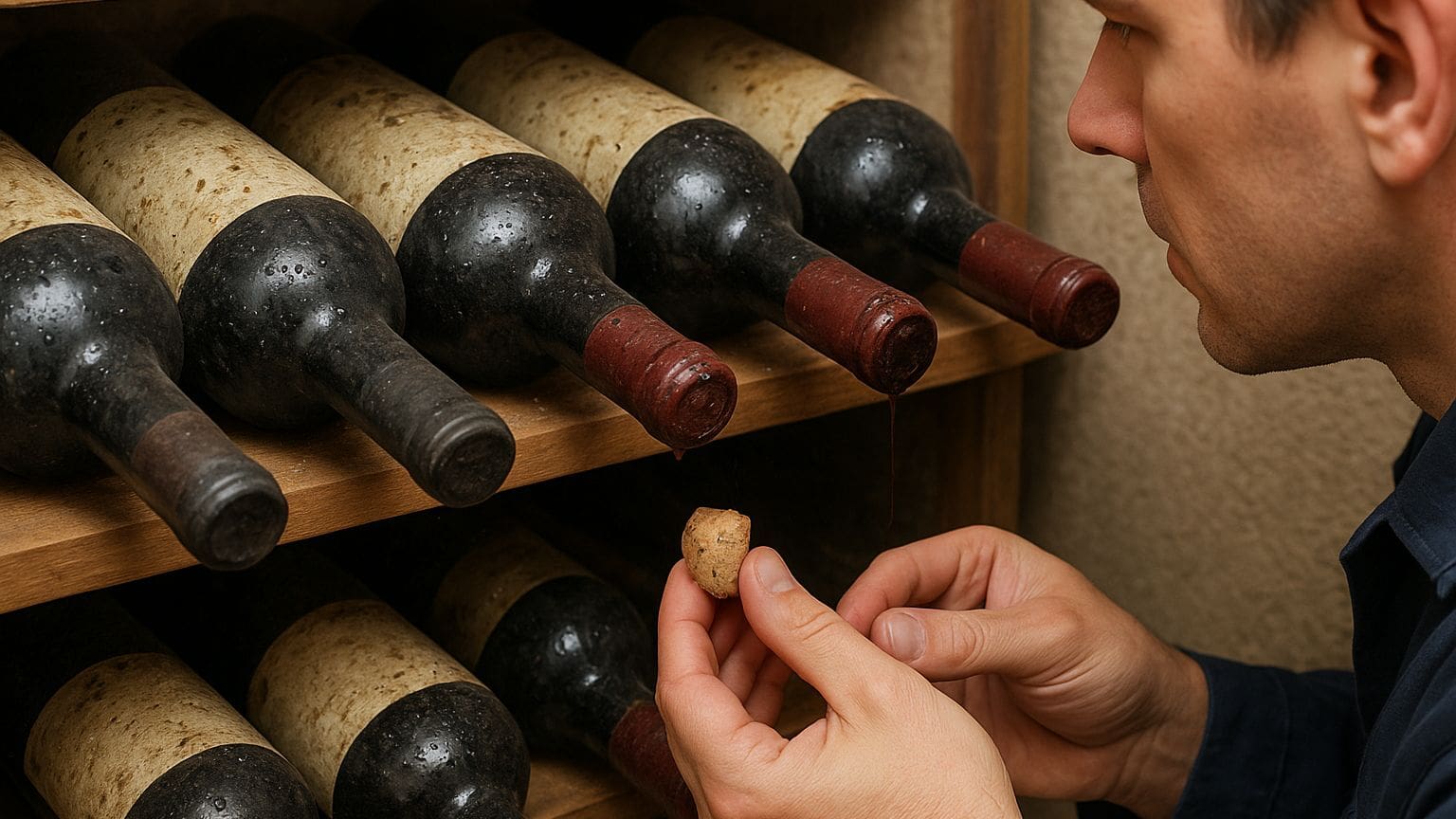
High-humidity symptoms reveal whether the main problem is condensation, infiltration, poor air circulation, leakage, or a cooling-system fault. Compare the hygrometer reading with air temperature, wall temperature, cooling-unit operation, and the location of visible damage. Surface moisture on one pipe tells a different story from dampness across every rack.
Run a 72-hour humidity investigation
- Record temperature and RH at bottle height every eight hours for three days.
- Place a second instrument at the opposite end of the cellar.
- Note door openings, rain, cleaning, equipment cycling, and water near the room.
- Use a data logger at 15–30-minute intervals for seven days if readings cycle sharply.
- Move one sensor near the suspected wet wall, drain, or cooling unit to identify local variation.
One reading above 80% does not prove permanent damage. Repeated readings above 80%, visible condensation, mold, damp labels, or a rapid rebound after drying point to an active problem. Ask yourself: does RH rise after every door opening, or does it return overnight with the door closed? That distinction separates infiltration from an internal leak or equipment fault.
Condensation on Walls, Bottles, or Cooling Equipment
Condensation forms when a surface falls below the dew point of surrounding air. Warm humid air contacting a cold wall, bottle, pipe, or evaporator coil releases water onto that surface. This explains why a room can show an acceptable average RH while one uninsulated pipe or exterior corner remains wet. The 2026 Wine Cellar Cooling protection guidance recommends examining insulation, cooling operation, and moisture movement together rather than treating condensation as a cosmetic issue.
- One cold pipe or corner: suspect missing insulation or a thermal bridge.
- Many bottles after a door opening: suspect warm humid air entering the room.
- Water beneath the cooling unit: inspect the pan, trap, pump, and condensate drain.
- Wet walls across a broad area: investigate RH, vapor movement, and water intrusion.
Mold, Musty Odors, and Deteriorating Wood
Inspect behind racks, beneath cases, around door frames, under flooring, beside condensate drains, and at wall penetrations. Poor air circulation creates stagnant moisture-prone pockets, so a small fan can improve distribution. Circulation alone does not remove water. A fan that merely moves damp air around the room cannot substitute for dehumidification.
Clean small surface areas only after moisture control begins. Wear suitable protection, isolate affected materials, and avoid disturbing extensive growth. Porous wood, drywall, insulation, or cardboard may need specialist assessment when contamination is widespread or the odor returns after seven days of stable readings.
Wet, Peeling, or Stained Labels
Uniform dampness across multiple bottles points toward room humidity or condensation. A sticky trail from the neck, capsule, or cork points toward leakage. Check for a lowered fill level, wine residue, a stained capsule, or a pushed cork. Isolate a leaking bottle in a temperature-stable location and photograph it before cleaning.
Dry labels with gentle airflow and leave space around them. Label damage does not prove oxidation, but leakage demands a closer inspection of the closure and fill level. For high-value collections, record bottle condition before moving cases so later changes can be distinguished from old damage.
Wine Cellar Humidity Troubleshooting Chart
| Symptom | Likely cause | Immediate fix |
|---|---|---|
| RH above 80% | Moisture entry, leak, inaccurate sensor, or failed equipment | Confirm with a second hygrometer and inspect vapor paths |
| Water below cooling unit | Blocked drain, failed pump, full pan, or poor slope | Protect bottles and service the condensate route |
| Wet bottles after door opening | Warm humid air reaching cold glass | Limit opening, repair the gasket, and stabilize the room |
| Mold behind racks | Stagnant air and moisture retained by porous materials | Move bottles carefully and inspect the wall and floor |
| One stained capsule or low fill | Bottle leakage or closure failure | Isolate and document the bottle |
| RH below 50% | Over-dehumidification, dry airflow, or inaccurate sensor | Confirm the reading and reduce drying toward 60–70% |
How to Choose Dehumidification and Climate-Control Equipment
A hygrometer measures the environment, a dehumidifier removes water, and a cooling unit transfers heat while potentially removing condensate. None repairs an open vapor path, leaking wall, blocked drain, or poorly sealed door. VintageView’s 2026 market overview projects a 6.4% compound annual growth rate from 2026 to 2033 for wine-cellar dehumidifiers. That market projection signals growing interest in dedicated equipment, not a guarantee that any particular unit will suit a cool cellar.
Dehumidifier selection
Choose by moisture-removal rate at the cellar’s actual operating temperature, continuous-drain capability, humidistat range, noise, service access, and heat output. A domestic compressor unit may be rated at warm room temperature yet lose performance near 55°F (13°C). A low-temperature compressor unit, desiccant unit, or integrated climate system may suit a cool cellar better.
Cellar volume alone does not determine capacity. A 20-square-metre room with an unsealed exterior wall and frequent door openings can receive more moisture than a larger sealed underground room. Use continuous drainage so a full reservoir cannot stop drying while the collection is unattended.
When the cooling unit can manage humidity
A cooling coil removes some humidity when moist air reaches a cold evaporator coil and condensate drains away. It removes little additional water when the room already sits at its target temperature, when the coil stays above the dew point, or when moisture enters faster than the system can condense it.
An oversized unit may short-cycle and create inconsistent drying; an undersized system may run continuously while failing to hold temperature. Confirm operating range, heat rejection, condensate routing, exhaust ventilation, and insulation before installation. The 2026 Wine Cellar Cooling protection guide treats those installation details as part of protecting the collection.
Hygrometer placement and calibration
Place sensors at bottle height, away from doors, supply outlets, exterior walls, direct sunlight, and condensate drains. Two sensors at opposite ends reveal stratification and localized cold-wall conditions. A saturated-salt check provides a practical household calibration test: in a sealed container, the sensor should approach approximately 75% RH after the solution and air equilibrate. Compare instruments rather than treating any single display as unquestionable.
Humidification and drainage
Use humidification only when verified readings remain below 50% after airflow and equipment checks. Cooling units and dehumidifiers both need a safe condensate route with no standing water, leaks, or blocked traps. Open water containers provide uncontrolled evaporation and can become a microbial growth source. A humidistat, clean water system, and maintenance schedule offer better control.
Cellar Construction: Insulation, Vapor Barriers, and Ventilation
A stable cellar needs continuous insulation, a correctly placed vapor barrier, sealed doors, controlled ventilation, low light, and airflow that reaches spaces behind and between racks. In tropical climates, warm outdoor air entering a cool room increases both sensible and latent cooling loads.
Seal vapor paths before adding capacity
Seal door gaps, floor joints, cable routes, plumbing openings, and service penetrations with compatible materials. Replace compressed gaskets and repair threshold gaps. Keep the vapor barrier continuous around the warm side of the insulated assembly. Do not seal an actively wet wall until the source has been identified; trapped water can damage framing and insulation.
Use controlled air circulation
Ventilation should remove stale air without importing Bangkok’s hot, moisture-laden outdoor air. Mechanical exhaust paired with filtered, conditioned make-up air works more reliably than an open grille. Keep air movement gentle; strong airflow aimed at corks and labels can create localized drying while room RH remains high.
Keep light and odors under control
Darkness, clean air, stable airflow, moderate humidity, and a steady temperature near 55–57°F (12–14°C) create cave-like storage conditions. Keep ultraviolet light away from Champagne, white Burgundy, Riesling, and delicate reds. Store wine away from solvents, fuel, paint, mold-contaminated wood, and strong cardboard odors.
Wine Cellar Versus Wine Refrigerator
A cellar is a room envelope; a wine refrigerator is a small insulated cabinet. A refrigerator usually regulates temperature more precisely because it controls less air volume, but many models do not actively maintain a selectable 60–70% RH band. A cellar offers more capacity while demanding better construction, drainage, ventilation, and monitoring.
| Feature | Dedicated cellar | Wine refrigerator |
|---|---|---|
| Temperature control | Depends on insulation and system sizing | Usually precise within the cabinet |
| Humidity control | Can use dedicated dehumidification or humidification | Often passive or incidental |
| Moisture risk | Doors, vapor paths, walls, drains, and condensation | Defrost cycles, dry airflow, and cabinet condensate |
| Maintenance | Envelope, cooling, drainage, sensors, and ventilation | Clearance, filter, drain, gasket, and sensor checks |
Store bottles horizontally, limit door openings, keep bottles away from direct cold-air outlets, and remove standing condensate. Do not place an open water bowl inside the cabinet. A refrigerator cannot solve mold, leakage, or high humidity in the surrounding room.
Managing Wine Cellar Humidity in Bangkok
Bangkok installations face high heat, humid outdoor air, heavy rain, and a large moisture penalty whenever the cellar envelope leaks. Every open door gap, unsealed pipe route, or uninsulated concrete section can bring water vapor into a room maintained near 13°C. A design that works in a dry temperate climate may run continuously in Bangkok.
Use continuous insulation and vapor-barrier protection around floors, ceilings, doors, wall penetrations, and service openings. Air-conditioning the adjacent room does not correct moisture passing through concrete or gaps. Seal and insulate before lowering the cellar set point or installing a larger dehumidifier.
Calculate cellar volume, wall exposure, insulation, door openings, bottle load, equipment heat, outdoor temperature, and measured moisture entry. Bangkok systems need capacity for latent heat—the energy required to remove water vapor—as well as sensible heat. Cooling exhaust must discharge into a ventilated area, while dehumidifiers need continuous drainage and service access.
Research by AK Rao, AJ Fix, YC Yang, and DM Warsinger published in 2022 examined sensor-based temperature and humidity control using feedback logic. A wine cellar does not need server-room complexity, but logged sensor data and humidity-based control can prevent long periods of unnoticed drift.
High-Humidity Wine Cellar Action Plan
First 24 hours
- Place two hygrometers at bottle height and photograph starting readings.
- Inspect the cooling unit, pan, drain, door gasket, threshold, walls, floor edges, and plumbing.
- Move leaking or dripping bottles to a dry, temperature-stable location without rapid warming.
- Separate damp cases and labels from wet surfaces.
- Stop unconditioned outdoor air from entering and provide gentle internal circulation.
- Do not heat the room or run an open water tray.
Next seven days
Review 15–30-minute logger readings for compressor cycling, humidity peaks, door events, and overnight recovery. Examine vapor barriers, insulation, wall penetrations, floor edges, condensate lines, and cooling-unit exhaust space. Keep storage near 55–59°F (12–15°C), prevent RH from falling below 50%, and look for dry surfaces, no returning odor, stable readings, and reduced equipment cycling.
When professional help is needed
Arrange professional help when RH remains above 80%, condensation returns, mold spreads through porous materials, water reaches electrical components, or the cellar fails to recover after 24–72 hours of source isolation and controlled drying. A refrigeration engineer can assess coil temperature, cooling capacity, condensate drainage, and heat rejection. A building specialist can inspect insulation, vapor barriers, drainage, and water intrusion.
Wine Cellar Humidity FAQs
Is 80% humidity too high for a wine cellar?
Persistent 80% RH is too high for a well-controlled cellar because it increases the risk of mold, damp labels, corrosion, and wet building materials. One brief spike does not condemn the wine. Confirm the reading, identify the source, and bring conditions gradually toward approximately 60% RH, consistent with 2026 wine-storage guidance.
Will high humidity ruin wine inside the bottle?
High room humidity does not automatically ruin sealed wine, but leakage, condensation, damaged closures, and prolonged poor storage can affect quality. Check fill level, capsule staining, seepage, cork movement, and odor.
Can I use a normal household dehumidifier at 55°F?
Some household compressor dehumidifiers lose performance or frost near 55°F (13°C). Check the manufacturer’s low-temperature range and extraction rate at that temperature. A low-temperature-rated appliance with continuous drainage is safer than choosing by warm-room capacity alone.
Should I leave the cellar door open?
Only as a short diagnostic measure when adjoining air is demonstrably cooler and drier. In Bangkok, an open door often introduces warmer, wetter air and raises condensation risk. A controlled, conditioned air path works better.
What humidity protects corks without causing mold?
Around 60% RH, with a practical 50–70% operating band, gives a useful balance. Cork condition also depends on closure quality, bottle position, airflow, and temperature, so room RH cannot compensate for a defective cork.
How often should a wine cellar be checked?
During a humidity event, log conditions every 15–30 minutes and inspect the room daily. After stabilization, review weekly peaks and lows, clean condensate routes on the equipment manufacturer’s schedule, and compare sensors periodically. A sudden change after cooling-system replacement deserves a service-history review rather than a larger dehumidifier by default.
Can a cooling-system replacement cause a humidity problem?
Yes. A wine room that once held a rock-solid 54°F with humidity in the low to mid-70s may rise into the 90s after an evaporator or compressor replacement if coil temperature, fan speed, drainage, refrigerant charge, or control logic changed. One documented cellar developed mold growth on a wood counter and shelves after a new evaporator was installed; later readings remained around 80–82% despite a countertop thermoelectric dehumidifier. That pattern points toward equipment diagnosis and moisture-load analysis, not simply leaving the door open.
How should wine professionals use a humidity-controlled cellar?
Build inspection into collection handling: check the sensor before a tasting, limit door-open time while guests browse, and return bottles promptly to stable storage. For client hosting, a Corporate VIP Wine Tasting benefits from a cellar that protects labels and bottles before service, while a planned event can use the Best Wine Tasting Experiences in Bangkok as a reference point for thoughtful wine presentation beyond temperature alone.
For advanced monitoring, pair two calibrated hygrometers with a data logger, record cooling-system replacement history, and compare RH against door events, rainfall, condensate output, and compressor cycles. Feedback-based environmental control research published in 2022 offers a useful technical direction: use the sensor record to tune the system instead of reacting to one alarming display.