Short answer: WSET suits structured wine theory, analytical tasting and internationally portable study. The Court of Master Sommeliers (CMS) suits restaurant-floor service, blind tasting and fine-dining progression. The Foundation of Sommelier Skills (FSS) suits people who want practical training for Thailand, including Thai and Western food pairing, service, wine-list work and hospitality experience.
None of these programs wins every comparison. They measure different abilities. WSET asks, “Can you explain and analyse wine?” CMS asks, “Can you perform as a sommelier under pressure?” FSS asks, “Can you use wine skills effectively in a real Thai hospitality setting?”
If you have searched for “WSET or CMS,” “sommelier certification Bangkok” or “which wine course should I take,” use this guide to compare qualification structure, exam style, tasting demands, service training, cost, language and career fit before you enrol.
One distinction shapes the entire decision: WSET is primarily a wine-education qualification route, CMS is a performance-led sommelier pathway, and FSS is a Bangkok-based practical skills program. A certificate can open a conversation with an employer, but your ability to taste accurately, communicate clearly and serve calmly will determine what happens next.
The Three Certifications in One Minute
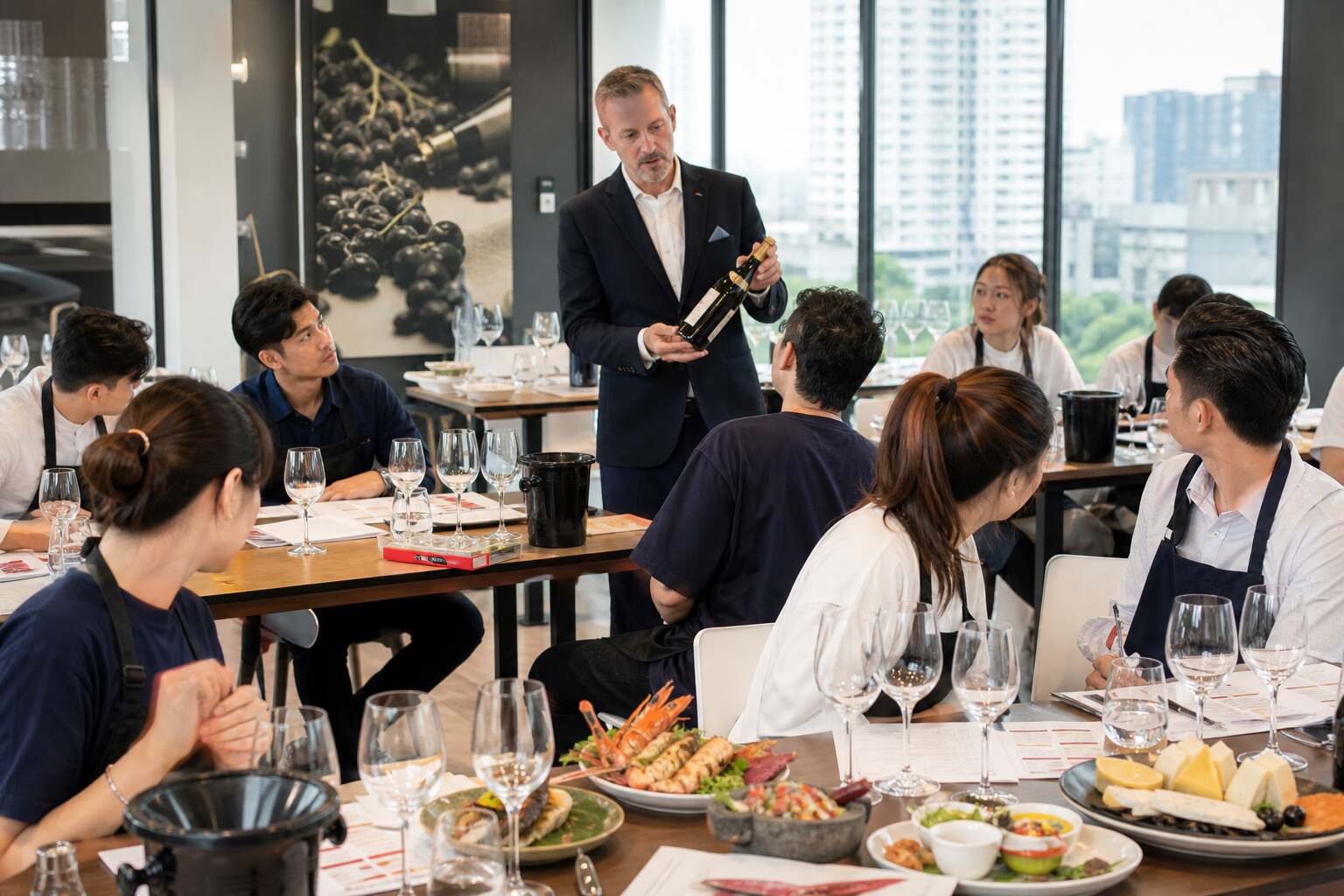
WSET — the structured theory path
The Wine & Spirit Education Trust, commonly called WSET, provides a staged route from introductory wine study to the Level 4 Diploma. Approved providers deliver courses in different formats, while each qualification follows its own learning outcomes and assessment requirements. WSET’s published course structure makes it a strong fit for wine retail, importing, distribution, buying, education, marketing and serious personal study. For Bangkok-specific context, compare the Bangkok sommelier course guide(opens in new tab).
Students develop a vocabulary for grape varieties, climate, soils, viticulture, winemaking, regional styles, faults, storage and commercial positioning. At higher levels, structured tasting turns sensory impressions into an organised analysis of appearance, nose, palate, quality, readiness and likely origin.
WSET study resembles building a detailed map. You learn where major regions sit, why their wines taste different and how production choices affect the finished bottle. That map helps when you work across suppliers, countries and categories rather than serving one restaurant’s list.
In one sentence: WSET teaches you to know, describe and analyse wine.
CMS — the performance and service path
The Court of Master Sommeliers is designed around professional sommelier performance. Its pathway progresses through Introductory, Certified Sommelier, Advanced Sommelier and Master Sommelier stages. The assessments combine beverage theory with blind tasting and, from the professional stages, service skills such as bottle presentation, decanting, opening sparkling wine, recommending bottles and responding to guests.
CMS blind tasting is not simply a test of whether you can recognise a grape. You must make a reasoned deduction from evidence: acidity, alcohol, tannin, body, flavour intensity, fruit profile, oak, climate clues and development. Then you need to communicate that reasoning clearly.
A service assessment adds another layer. Can you greet a guest, clarify preferences, recommend within a budget, present the bottle, open it cleanly, manage glassware and protect the rhythm of the table? CMS places those decisions closer to the centre of the learning experience than a conventional written wine qualification.
The Master Sommelier examination has a selective history, but changing candidate numbers and title-holder totals should not be repeated as permanent statistics. Check the relevant official CMS announcement for current examination information before using historical pass-rate claims to plan your career.
In one sentence: CMS trains you to perform, serve and make decisions on the restaurant floor.
FSS — the Thailand-focused practical path
The Foundation of Sommelier Skills (FSS) is the progressive program taught by Wine & Spirit Academy Bangkok. Its four stages are Basic, Intermediate, Advanced and Essentials. The curriculum combines wine theory, analytical tasting, service, menu-based pairing and hospitality application, with teaching available in English or Thai according to the course offering.
FSS places the classroom closer to the realities of Bangkok hotels, restaurants, wine bars, retailers and distributors. Students work with decisions they may face during a shift: how to describe a bottle to a guest, how to handle a service sequence, how to pair wine with spicy or aromatic food, how to construct a wine list and how to explain value without overwhelming the customer.
The capstone, Essentials of Sommelier Skills (ESS), is presented by the academy as a 14-day program comprising 98 hours plus an examination day. The published program information describes 112 wines, viticulture, winemaking, French and international regions, sparkling and fortified wines, professional service, wine-list development, costing, upselling, advanced food pairing and an internship component. See the academy’s 2026 Bangkok sommelier course information(opens in new tab) and confirm the current intake, assessment weighting and internship conditions directly with the provider.
In one sentence: FSS trains you to use wine skills at work in Thailand, not just discuss them in an examination room.
WSET vs CMS vs FSS: side-by-side comparison
| Criteria | WSET | CMS | WSA FSS |
|---|---|---|---|
| Origin and identity | Wine education organisation with a staged qualification framework | Professional sommelier body centred on service and examination performance | Bangkok-based sommelier-skills program designed for practical hospitality training |
| Structure | Level 1, Level 2, Level 3 and Level 4 Diploma | Introductory, Certified, Advanced and Master Sommelier | Basic, Intermediate, Advanced and Essentials |
| Primary emphasis | Theory, regions, production and structured tasting | Theory, deductive blind tasting and live service | Theory, tasting, service, pairing and Thai-market application |
| Blind tasting | Appears in higher-level study and assessment | Central from the professional stages | Practised as part of practical sommelier development |
| Table service | Not the central assessment focus | Core professional skill | Core practical skill |
| Food pairing | General principles and style analysis | Useful for service, though the pathway centres on sommelier performance | Thai and international cuisine form a central practical context |
| Internship | Not a standard built-in feature of the qualification pathway | Not a standard built-in feature of the qualification pathway | Included in the ESS program description; verify current placement terms |
| Teaching language in Bangkok | Provider-dependent, commonly English | English-language professional terminology is generally used | English and Thai options are offered by the academy |
| Assessment character | Written examinations, with tasting assessment at relevant higher levels | Theory, blind tasting and service assessment | The academy describes a written and tasting assessment structure; confirm the current weighting |
| Best career fit | Trade, education, buying, distribution and global wine knowledge | Restaurant sommellerie and fine-dining progression | Thai hospitality, practical restaurant work and career changers |
| Portability | Strong international recognition through the WSET framework | Strong recognition in professional sommelier circles | Strongest direct relevance to the Thai hospitality market |
The table shows why a simple “best certification” ranking breaks down. WSET has breadth, CMS has service intensity and FSS has local application. Which gap would create the greatest problem in your next role?
How the study experience differs
WSET: build a reliable mental map
WSET study rewards organisation. You learn to connect cause and effect:
- Climate influences ripeness, acidity and alcohol.
- Grape variety contributes identifiable structural and aromatic patterns.
- Winemaking choices alter texture, oak influence, extraction and ageing potential.
- Regional rules and traditions shape the style in the glass.
- Price, quality and readiness require separate judgements.
That framework works well when you need to compare wines across countries. It also helps a buyer explain why a cool-climate Chardonnay differs from a warm-climate Chardonnay without reducing the discussion to “I like it” or “I do not like it.”
A practical WSET revision routine might look like this:
- Read the learning outcome before opening a chapter.
- Build a region-and-grape grid rather than copying isolated notes.
- Taste one contrasting pair, such as cool-climate and warm-climate Chardonnay.
- Write a short structured tasting note from memory.
- Finish with exam-style questions that test cause and effect.
CMS: turn observation into a service decision
CMS study feels closer to athletic preparation. You taste repeatedly, practise recall, rehearse service movements and learn to speak while making decisions. A candidate might need to identify a wine’s likely category, explain the deduction, recommend it with a dish and then execute the service correctly.
CMS preparation normally benefits from a tasting group and a consistent deductive grid. Start with appearance, then assess aroma condition, fruit character, non-fruit notes, acidity, tannin, alcohol, body, intensity and finish. Do not leap to grape variety after smelling one familiar aroma. Build the call from several clues.
Ask yourself a practical question: can you carry theory into a busy dining room while a guest waits, a bottle needs opening and a table has conflicting preferences? CMS places that pressure at the centre of the path.
FSS: practise the complete hospitality interaction
FSS connects tasting to the guest experience. A class may move from identifying acidity and body to deciding whether a wine can handle chilli, herbs, coconut milk, grilled meat or a sweet-and-sour sauce. The answer must account for the dish, the guest, the service temperature, the glassware and the price point.
For example, a high-acid Riesling might refresh a dish with heat and aromatic herbs, while a heavily tannic red could make intense chilli feel harsher. A lightly sweet wine may work better with heat than a very dry, high-alcohol alternative. The exact bottle still depends on preparation, sweetness, salt, texture and the guest’s preference.
Wine colour also changes the conversation. Use the guide to Red Wine vs Rose when comparing body, acidity, serving context and pairing language for guests who want a quick, accessible explanation.
Which certification should you choose?
Choose WSET if you want global wine knowledge
Choose WSET when you want a qualification that supports mobility across the wine trade. It fits aspiring importers, distributors, educators, retail specialists, buyers, marketers and hospitality professionals who want a systematic foundation.
WSET also suits self-directed learners who prefer a defined syllabus and written assessment. Start at Level 1 if wine is new to you. Level 2 offers broader coverage for learners with basic familiarity. Level 3 demands more detailed analysis and tasting. The Diploma represents a substantial academic and professional commitment rather than a casual extension of an introductory course.
WSET may not satisfy you if your immediate need is tray handling, bottle presentation, decanting or fast guest interaction. Those skills require deliberate practical rehearsal.
Choose CMS if you want professional restaurant service
CMS makes sense when your target role sits on the restaurant floor. It suits working sommeliers, fine-dining servers, beverage directors and candidates who want to develop under a service-led benchmark.
Prepare for a demanding cycle of theory, tasting and service practice. Build a tasting group, use a consistent deductive framework, memorise classic regions and rehearse service until each movement looks calm.
CMS becomes a poor first choice when you only want to understand wine for personal enjoyment or when you cannot regularly practise in a restaurant environment. The credential’s value rises with the work context around it.
Choose FSS if Thailand is your working market
FSS fits hotel and restaurant teams, F&B managers, aspiring sommeliers, wine sales professionals and career changers based in Thailand. It also suits learners who want English or Thai instruction and who need food-pairing examples that extend beyond European cuisine.
The ESS route concentrates professional content into an immersive format described by the academy as 14 days and 98 hours, followed by an examination day. The program information also lists 112 wines, service, wine-list development, costing, upselling, pairing and internship experience. Verify the timetable and inclusions before making a payment.
FSS carries a different kind of value from WSET or CMS. It should not be presented as a substitute for every international credential. Its advantage lies in immediate relevance: learning that can be applied during the next shift in a Bangkok restaurant, hotel or wine business.
Choose a shorter route if you are a wine enthusiast
Enthusiasts often gain more from a focused introductory course than from an advanced professional examination. WSET Level 1 or Level 2 can provide a structured vocabulary. FSS Basic or Intermediate can add hands-on service, tasting and Thai food pairing. CMS is usually less efficient for a hobbyist because its professional service demands become central as you progress.
What do you want to do after class: identify a wine, host a dinner, recommend bottles to guests or change careers? Your answer matters more than the logo on the certificate.
A practical decision process for Bangkok students
- Name the job you want. Write “buyer,” “restaurant sommelier,” “wine educator,” “hotel F&B manager” or “confident host,” not simply “work with wine.”
- Measure your weekly availability. A compact intensive, a staged evening course and a multi-stage diploma create very different routines.
- Choose your assessment comfort zone. Do you prefer written theory, deductive tasting, live service or a combination?
- Check the language of instruction. Technical English may be manageable for one learner and a serious barrier for another. FSS offers a local bilingual option according to the academy’s course information.
- Calculate the complete cost. Include tasting practice, travel, accommodation, missed work, books, exam fees and resits—not only the advertised tuition.
- Ask for the current syllabus. Confirm wine numbers, tasting format, internship arrangements, assessment weighting, class dates and what the fee includes.
This six-step check prevents a common mistake: choosing the most familiar qualification instead of the one that matches the next role.
Can you combine WSET, CMS and FSS?
Yes. The programs can complement one another because their strengths differ.
- Begin with FSS Basic if you need practical foundations and want to use new skills at work quickly.
- Progress through Intermediate and Advanced to deepen tasting, service and pairing.
- Use ESS for an intensive professional foundation, including the academy-described 112-wine tasting program and internship component.
- Add WSET Level 3 or the Diploma when you need more portable theory and a broader academic framework.
- Consider CMS when your experience and career direction point toward advanced restaurant service and blind tasting.
A practical-first sequence can make later theory easier to absorb. Conversely, a WSET foundation can give a service professional a stronger explanation for decisions made tableside.
Cost and time in Bangkok
The figures below are indicative Bangkok course information, not a universal fee schedule. WSET and CMS prices vary by provider, examination location, exchange rate, course format and resit policy. FSS fees and format can also change by intake. Confirm every figure before enrolling.
| Stage | WSET indicative range | CMS indicative range | WSA FSS published course information |
|---|---|---|---|
| Entry | Level 1: approximately ฿9,500–12,000 | Introductory: approximately ฿22,000–28,000 | Basic: ฿8,500 |
| Second stage | Level 2: approximately ฿20,000–30,000 | Certified: approximately ฿15,000–25,000 before wider preparation costs | Intermediate: ฿16,000 |
| Third stage | Level 3: approximately ฿40,000–60,000 | Advanced: course, examination and travel costs vary | Advanced: approximately ฿25,000 |
| Advanced route | Diploma: approximately ฿150,000–250,000 or more across the full commitment | Master Sommelier: multi-stage preparation and travel costs vary | Essentials: ฿109,000, described as a 14-day intensive |
Price alone can mislead. A lower tuition fee may exclude examination, books, tasting wines or travel. A bundled intensive may cost more at checkout while reducing separate expenses. Compare the complete learning package line by line.
A simple Bangkok study budget
- Course fee: tuition, materials and included tastings.
- Assessment: examination, registration and possible resit charges.
- Practice: bottles for calibration, tasting glasses and storage.
- Work impact: unpaid leave, shift swaps or lost service income.
- Travel: transport and accommodation for courses or examinations outside Bangkok.
Two courses with similar advertised prices can produce very different final costs. Ask for an itemised quotation rather than comparing headline numbers.
Transparency about FSS
FSS is taught by Wine & Spirit Academy Bangkok, so this page discusses one of our own programs. That relationship deserves a clear disclosure. WSET and CMS remain separate organisations with their own standards, assessment systems and employer recognition.
FSS is a sensible choice for Thailand-focused practical training; WSET may serve a student seeking broader international theory recognition; CMS may serve a candidate targeting high-level restaurant sommellerie. Review the official syllabus and speak with the provider before relying on any comparison.
- Four progressive stages: Basic, Intermediate, Advanced and Essentials.
- Practical service and tasting throughout the pathway.
- Thai and international food-pairing application.
- English and Thai learning options according to course availability.
- ESS program information describing 14 days, 98 hours, 112 wines and an internship component.
Frequently Asked Questions
Is FSS internationally recognised like WSET?
WSET has broader international portability as a dedicated global qualification framework. FSS is positioned around Thai hospitality and local professional application. Students pursuing international mobility may combine FSS practical training with WSET study. Treat the two certificates as complementary rather than identical.
Is CMS better than WSET for becoming a sommelier?
CMS is the closer match for a restaurant-floor sommelier because service and performance sit at the centre of its pathway. WSET gives broader structured knowledge and can support many wine careers outside table service. A restaurant professional may benefit from both.
Do I need WSET before CMS or FSS?
No prerequisite applies to the beginner route in this comparison, but CMS Introductory candidates benefit from basic familiarity with wine. Check current CMS eligibility rules and the provider’s entry requirements. FSS Basic and WSET Level 1 are suitable starting points for learners with limited prior knowledge.
Which course is best for Thai food pairing?
FSS has the clearest Thailand-specific pairing orientation in this comparison. Its practical approach can address chilli, herbs, fermented flavours, sweetness, acidity, coconut-based dishes and textural contrast alongside international food. WSET teaches transferable pairing principles, while CMS develops pairing as part of professional beverage service.
What is Essentials of Sommelier Skills?
ESS is presented as the fourth FSS level after Basic, Intermediate and Advanced. The academy describes it as a 14-day, 98-hour intensive plus an examination day, with 112 wines tasted and content covering viticulture, winemaking, French and international regions, sparkling and fortified wine, service, wine lists, costing, upselling and food pairing. Confirm current dates, assessment details and internship terms directly with WSA.
How long does each pathway take?
WSET can range from a short introductory course to a multi-stage Diploma commitment. CMS begins with an introductory stage and can extend over several years as candidates prepare for advanced examinations. FSS is modular, while ESS is described as a 14-day intensive. The right timeline depends on whether you study alongside full-time hospitality work.
Do Bangkok hotels prefer WSET, CMS or FSS?
Hiring preferences differ by property, role and manager. International hotel groups may recognise WSET terminology; fine-dining restaurants may value CMS training; Thai venues may prioritise practical service, pairing and communication skills. Read the job description, ask the beverage director what the team uses and choose the qualification that closes your specific skills gap.
Can a wine enthusiast start with CMS?
You can, but the choice may not match your goal. CMS becomes increasingly centred on restaurant service, deductive tasting and professional performance. WSET Level 1 or Level 2 usually offers a more direct route for structured personal study, while FSS Basic adds practical service and Thai-food pairing.
What should I ask a Bangkok provider before paying?
- Which wines and regions will the class taste?
- Who teaches the sessions, and what professional experience do they bring?
- What exactly does the tuition include?
- Is the examination included, and what happens after an unsuccessful attempt?
- How much service practice will each student receive?
- Is the internship guaranteed, arranged or optional?
- Which language will instructors use for technical explanations?
- Can the timetable accommodate full-time work?
For current FSS dates, fees and eligibility, contact Wine & Spirit Academy Bangkok at 099-016-8838 and request the latest written course outline before reserving a place. For deeper preparation, compare a provider’s tasting schedule against the assessment format you plan to face—written analysis, blind deduction or live service—before selecting your first practice set.