What Is Wine Body Assessment? 5 Steps to Judge Texture
Wine Body Assessment: What Are You Judging?
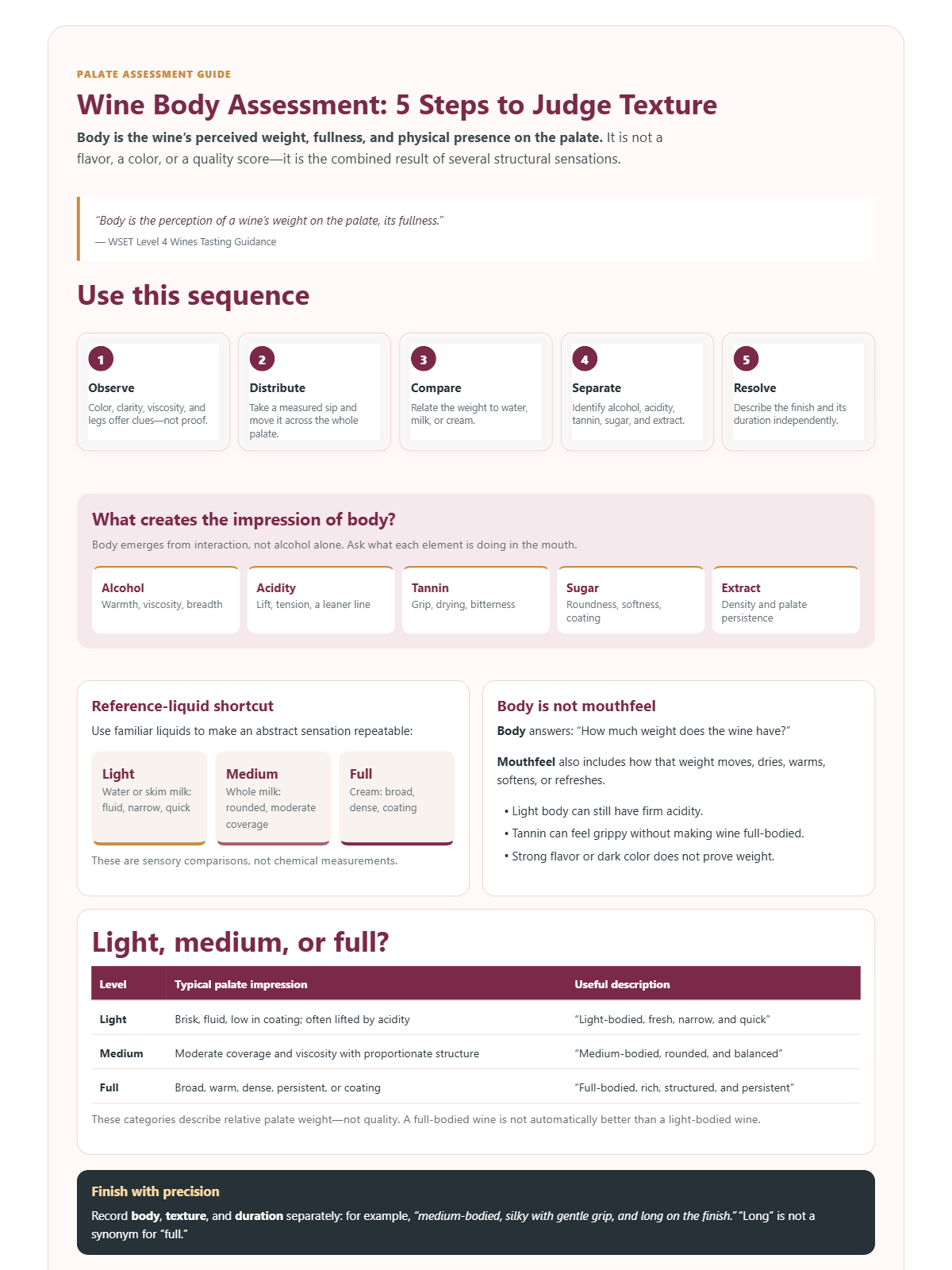
Wine body assessment judges the overall weight, fullness, and physical presence of wine on the palate. The Court of Master Sommeliers, Americas uses three broad categories—light, medium, and full—while WSET describes body as a combined mouth sensation produced by sugar, acidity, tannin, and alcohol.
Body is not a single measurable flavor. It is the impression created when several structural elements arrive together: alcohol may create warmth and viscosity, sugar may add roundness, tannin may add grip, and acidity may sharpen the wine while making it feel leaner. Two wines with similar alcohol levels can therefore feel very different if one has higher acidity or more tannin.
“Body is the perception of a wine’s weight on the palate, its fullness.” — WSET Level 4 Wines Tasting Guidance
How Does Wine Body Relate to Mouthfeel?
Mouthfeel is the wider category, while body describes one major part of that physical sensation. Mouthfeel includes weight, viscosity, smoothness, creaminess, astringency, warmth, freshness, carbonation, and the way the wine changes across the palate. WSET’s sensory-training materials distinguish texture—such as sleek, silky, velvety, or rough—from structure, which includes acidity, tannin, and body.
A wine may have light body but a firm texture. A high-acid Riesling, for example, can feel narrow, energetic, and sharply focused without becoming heavy. A tannic red may feel rough or grippy even when its alcohol and extract do not create a full-bodied impression. Body answers “How much weight does the wine have?” Mouthfeel also asks “How does that weight move, press, dry, or soften in my mouth?”
What Is the Difference Between Body, Flavor, Sweetness, Color, Tannin, and Quality?
Body, flavor, sweetness, color, tannin, and quality describe different wine attributes. Flavor identifies what the wine tastes and smells like, such as citrus, cherry, blackcurrant, spice, or toast. Sweetness describes the perception of residual sugar. Color describes appearance. Tannin creates drying, grippy, or astringent sensations. Quality evaluates balance, intensity, complexity, persistence, and typicity rather than weight alone.
| Attribute | What it describes | Why it should remain separate from body |
|---|---|---|
| Body | Weight and fullness on the palate | A structural impression formed by several components |
| Flavor | Aromas and taste characteristics | A strongly flavored wine may still feel light |
| Sweetness | Sugar-related taste sensation | Dry wines can be full-bodied, and sweet wines can be light-bodied |
| Color | Visual hue and intensity | Pale wines can have substantial alcohol or extract |
| Tannin | Drying, bitter, or grippy texture | Tannin adds structure but does not automatically equal weight |
| Quality | Balance, complexity, precision, and persistence | A full-bodied wine is not automatically better than a light-bodied wine |
The Court of Master Sommeliers, Americas lists sweetness, acidity, alcohol, body, and tannin as separate palate-structure fields. That framework prevents a common tasting error: assigning a quality judgment before identifying the individual sensations that create the wine’s shape.
5 Steps to Judge Wine Texture and Body
A consistent body assessment follows a sequence of observation, palate contact, comparison, structural analysis, and finish evaluation. Australian Wine Discoveries presents a five-step tasting process that moves from examining and smelling the wine to tasting, assessing balance, and reaching a conclusion; its body scale compares wine with non-fat milk, whole milk, and heavy cream.
- Observe appearance without treating color as proof of body.
- Take a measured sip and distribute it across the palate.
- Compare the weight with familiar reference liquids.
- Separate the effects of alcohol, acidity, tannin, sugar, and extract.
- Describe the finish with precise texture terms.
1. Observe the Wine’s Color, Viscosity, and Wine Legs
Begin with visual evidence, but treat it as a prediction rather than a verdict. Tilt the glass over a white background and note color intensity, opacity, clarity, and the speed at which the wine moves down the bowl. A wine that appears dense and slow-moving may contain higher alcohol, sugar, extract, or glycerol, but the visual impression cannot isolate which component creates that effect.
Wine legs or tears form when liquid drains down the glass after swirling. They reflect evaporation, surface tension, and viscosity; alcohol and sugar can influence the pattern, but legs do not provide a reliable standalone measurement of body. The U.S. Alcohol and Tobacco Tax and Trade Bureau also shows why label-based assumptions need caution: for wines between 7% and 14% alcohol by volume, a numerical alcohol statement may be optional when the label uses “table wine” or “light wine.”
2. Take a Measured Sip and Move the Wine Across Your Palate
A measured sip reveals body more accurately than a large mouthful. Take enough wine to coat the tongue and cheeks, then move it from the front of the mouth toward the sides and back. Notice whether the wine spreads quickly like water, rolls with moderate weight, or clings with a thick, creamy, or dense sensation.
Pay attention to the wine’s first contact, middle-palate expansion, and final release. Light-bodied wine often arrives quickly and exits cleanly. Full-bodied wine usually occupies more of the palate and creates a stronger sense of coating, warmth, or persistence. Carbonation, acidity, tannin, and alcohol can interrupt that sequence, so assess weight separately from prickling, drying, or burning.
3. Compare the Weight to Water, Skim Milk, Whole Milk, or Cream
Reference liquids convert an abstract impression into a repeatable comparison. Water represents minimal weight, skim milk suggests light body, whole milk indicates medium body, and cream represents a fuller, richer sensation. Australian Wine Discoveries uses a three-level comparison involving non-fat milk, whole milk, and heavy cream.
The comparison works best when you ask one question at a time: “Does the wine feel thinner than whole milk?” “Does it coat the mouth like cream?” “Does it move with the fluidity of water, or does it retain a broader, slower presence?” These comparisons describe sensation rather than chemical composition, so they should support—not replace—your assessment of acidity, alcohol, tannin, sugar, and extract.
4. Assess Alcohol, Acidity, Tannin, Sugar, and Dry Extract
Body emerges from the interaction of several structural components rather than from alcohol alone. WSET identifies alcohol as the main contributor to body in most wines, while sugar and grape extract add weight and high acidity makes wine feel lighter. WSET also places alcohol below 11% ABV in the low range, from 11% to 13.9% ABV in the medium range, and at 14% ABV or above in the high range.
- Alcohol: Look for warmth, viscosity, and a broader palate impression.
- Acidity: Look for mouth-watering, tension, lift, and a leaner line.
- Tannin: Look for drying, grip, bitterness, and tactile structure.
- Sugar: Look for sweetness, roundness, softness, and coating.
- Dry extract: Look for density and material that remains after the liquid moves away.
Dry extract is difficult to identify in isolation during casual tasting, so describe the sensory result rather than claiming a laboratory value. “Dense and coating” is defensible; “high dry extract” requires production information or analysis.
5. Describe the Finish Using Texture Terms such as Silky, Rich, Structured, or Grippy
The finish shows how the wine’s texture resolves after the sip. “Silky” suggests smooth, low-friction movement. “Rich” suggests broad weight and a generous coating sensation. “Structured” indicates that acidity, tannin, or both hold the palate in place. “Grippy” describes tannin that creates friction and drying, especially along the gums.
Do not use “long” as a substitute for “full.” A light-bodied wine may have a long, mineral, high-acid finish, while a full-bodied wine may finish abruptly if alcohol, oak, or tannin dominates. Record the final texture and the duration separately; that distinction produces a more accurate tasting note.
Light-, Medium-, and Full-Bodied Wine: A Practical Comparison
The three body categories describe relative palate weight, not a hierarchy of quality. The Court of Master Sommeliers, Americas uses light, medium, and full as broad body levels, while WSET adds more detail to alcohol assessment through low, medium, and high ranges. Australian Wine describes light-bodied wine as lighter and less viscous and full-bodied wine as heavy or creamy.
Light-Bodied Wine: Delicate Weight and Brisk Palate Feel
Light-bodied wine feels relatively narrow, fluid, and low in palate weight. It may show low or moderate alcohol, high acidity, limited sugar, and restrained extract. Pinot Noir and Sauvignon Blanc often appear toward the lighter end of body when their acidity and alcohol create a brisk, lifted profile, according to WSET’s wine terminology guidance.
Light body does not mean weak flavor. A pale, aromatic wine can deliver intense citrus, floral, herbal, or mineral character while remaining delicate in texture. Describe the wine as “light-bodied with pronounced aromatic intensity” when flavor concentration exceeds physical weight.
Medium-Bodied Wine: Balanced Weight, Texture, and Palate Coverage
Medium-bodied wine occupies the middle ground between fluidity and density. It usually spreads across the palate without becoming heavy, and its acidity, alcohol, tannin, sugar, and extract remain proportionate. WSET places most table wines in the medium alcohol range of 11% to 13.9% ABV, although alcohol level alone does not determine the final body assessment.
A medium-bodied wine may feel fresh, supple, savory, creamy, or lightly tannic. Its texture becomes more informative when paired with a finish description: “medium-bodied, supple, and gently grippy” communicates more than “medium-bodied” alone.
Full-Bodied Wine: Rich Weight, Density, and Persistence
Full-bodied wine creates a broad, substantial, and often coating impression. Higher alcohol, ripe tannin, residual sugar, grape extract, oak influence, or a combination of these elements can increase perceived fullness. WSET’s tasting guidance states that sugar and grape extract add to body, while generally high levels of tannin make wine feel fuller-bodied.
Full body can feel creamy, dense, warm, powerful, or velvety. Those terms are not interchangeable: “creamy” emphasizes softness, “dense” emphasizes concentration, “warm” emphasizes alcohol, and “velvety” emphasizes smooth tannin. A precise assessment selects the texture that the palate actually shows.
Body Assessment Table: Indicators, Common Varieties, and Tasting Examples
| Body level | Typical indicators | Common examples | Useful tasting description |
|---|---|---|---|
| Light | Brisk acidity, lower viscosity, modest alcohol, limited coating | Sauvignon Blanc, Pinot Noir, Vinho Verde | “Light-bodied, fresh, narrow, and quick on the finish” |
| Medium | Moderate palate coverage, balanced structure, moderate viscosity | Chardonnay, Merlot, Grenache | “Medium-bodied, rounded, and balanced by fresh acidity” |
| Full | Broad weight, warmth, density, ripe tannin, sugar, or extract | Warm-climate Chardonnay, Cabernet Sauvignon, Southern Rhône red | “Full-bodied, rich, structured, and persistent” |
Why Wine Can Feel Structured Without Being Full-Bodied
Structure and body are related but independent sensations. The Court of Master Sommeliers, Americas assesses sweetness, acidity, alcohol, body, and tannin as separate palate fields, allowing a wine to show high acidity or firm tannin without automatically receiving a full-body rating.
How Can Acidity Make a Wine Feel Firm, Focused, or Lean?
Acidity makes wine feel firm and focused by increasing salivation and narrowing the palate impression. WSET states that high acidity can make a wine seem lighter-bodied, while its current sensory guidance distinguishes acidity’s mouth-watering effect from alcohol’s warming effect.
A high-acid wine may therefore feel energetic rather than substantial. The palate tightens, flavors appear more linear, and the finish remains refreshing. If the wine also contains high alcohol or sugar, those components may broaden the sensation, creating a wine that feels both fresh and weighty.
How Does Tannin Create Grip and Structure Without Adding Weight?
Tannin creates grip through astringency and drying, not through the same mechanism that creates viscosity. Fine, ripe tannin may feel polished or velvety, while coarse tannin can feel rough and abrasive. WSET notes that low levels of unripe, astringent tannin may make a wine seem harsher, thinner, and lighter even though the wine remains structurally firm.
Consider a lean red with pronounced tannin and high acidity. It may feel angular, drying, and tightly built rather than full. The correct assessment separates “medium-bodied” from “high tannin” instead of allowing the drying sensation to inflate the body judgment.
When Do Alcohol, Sugar, and Dry Extract Increase Perceived Body?
Alcohol, sugar, and extract increase perceived body when they broaden, soften, or coat the palate. Alcohol often supplies warmth and viscosity; sugar adds roundness; extract contributes density and persistence. WSET’s mouthfeel guidance describes sugar as contributing weight and roundness and gives high-alcohol, high-extract Rhône red as an example of a full-bodied wine with a warm finish.
These components can also become excessive. High alcohol may taste hot rather than rich, sugar may feel cloying rather than creamy, and extract may create heaviness without balance. Assess the sensation first, then decide whether the structural components integrate successfully.
Visual Cues and Serving Conditions: What Wine Body Assessment Can and Cannot Reveal
Appearance and serving conditions influence body perception, but neither one can replace palate assessment. Glass shape, pour size, temperature, lighting, and recent food or drink all affect how texture appears and feels. WSET’s palate-training guidance specifically identifies temperature, lighting, food, and glassware as factors that influence sensory evaluation.
Why Darker Color May Suggest Richness but Cannot Prove Full Body
Darker color may suggest skin contact, extraction, oak influence, or concentration, but it cannot prove full body. Color primarily reflects grape pigments, production choices, age, and oxidation, while body depends on the combined palate structure. A deeply colored wine can feel lean if acidity dominates; a pale wine can feel broad if alcohol, sugar, or extract supplies weight.
What Do Wine Legs Indicate About Alcohol, Sugar, and Viscosity?
Wine legs indicate liquid behavior on glass rather than a direct body score. Alcohol, sugar, temperature, glass cleanliness, and surface tension influence the tears that form after swirling. Legs may support a hypothesis about viscosity, but the tasting palate must confirm whether the wine actually feels broad, rich, or coating.
Label alcohol provides context but not certainty. The TTB allows a tolerance of 1.5 percentage points for specific alcohol statements on wines containing 14% alcohol by volume or less, subject to the applicable labeling rules.
How Do Serving Temperature and Winemaking Change Perceived Texture?
Temperature changes the balance between freshness, alcohol warmth, tannin, and viscosity. The Fédération Suisse de l’Apéritif recommends light red wines at 12–16°C and tannic or aged red wines at 16–18°C, showing that different wine styles require different tasting conditions.
Winemaking also changes texture through skin extraction, fermentation choices, lees contact, malolactic conversion, oak maturation, residual sugar, and alcohol level. Compare the same wine at two temperatures only after identifying the condition being tested; otherwise, a warmer serving temperature may be mistaken for greater body when the main change is stronger alcohol warmth.
Pitfalls to Avoid When Judging Wine Body
Accurate body assessment depends on separating visual intensity, flavor intensity, acidity, tannin, and alcohol warmth from actual palate weight. A disciplined taster records each sensation independently before assigning light, medium, or full body.
Mistaking Strong Flavor or Dark Color for Full Body
Strong flavor and dark color do not automatically indicate full body. A concentrated aroma profile can belong to a light-bodied wine, while a deeply colored red can remain lean if acidity and tannin dominate. Use body language only after the wine has physically moved across the palate.
Confusing High Acidity or Tannin with Heavy Mouthfeel
High acidity and tannin may create firmness without creating weight. Acidity produces lift and salivation; tannin produces grip and drying. WSET’s guidance explicitly separates these sensations from body and warns that high acidity can make a wine feel lighter, while unripe tannin can make it seem harsher and thinner.
Overrelying on Wine Legs Instead of Tasting the Palate
Wine legs should remain a secondary visual clue. Swirl the glass, observe the tears, and then test the liquid in your mouth. WSET also warns that perceived alcohol and labeled alcohol do not always match: a wine labeled at 13.5% ABV may still taste high in alcohol if it creates noticeable warmth.
Next Steps: Build a More Consistent Wine Tasting Assessment
Consistency improves when you taste repeated samples under controlled conditions and record body separately from the other structural fields. Use the same glassware, serving temperature, pour size, tasting order, and palate-reset routine for each comparison. Then write one body judgment, one texture judgment, and one finish judgment instead of compressing all three into a single adjective.
The International Organisation of Vine and Wine recommends introducing three identical samples within a series of at least six samples to monitor assessor repeatability. A 2024 standardized wine sensory-analysis study also used duplicate analysis and included six duplicate samples in its repeatability calculations.
- Taste six wines without seeing the labels.
- Place three identical samples at different points in the sequence.
- Record body, acidity, alcohol, tannin, sweetness, texture, and finish independently.
- Compare your repeated judgments after the tasting.
- Investigate any large difference before changing your vocabulary.
For a practical assessment sentence, use this order: body + texture + structural driver + finish. For example: “Medium-bodied, silky and fresh, with moderate alcohol, fine tannin, and a long, lightly grippy finish.” That format turns the broad category of wine body into a repeatable sensory observation.