Wine body is perceived weight—not a quality score
Body describes the wine’s substance, tactile presence, and persistence in the mouth. Assess it through texture and palate behavior, then record sweetness, acidity, tannin, alcohol, flavor intensity, and finish separately.
“Body” is best treated as a composite mouthfeel impression rather than a direct reading of alcohol, sugar, or color.
Delicate, brisk, narrow, and quick to clear.
Ask: Does little coating remain after swallowing?
Rounded, balanced, and moderately present.
Ask: Does it occupy the palate without feeling dense?
Broad, dense, coating, and persistent.
Ask: Does substance remain after acidity fades?
Do not collapse every sensation into “body”
Body
Overall impression of weight, volume, coating, and persistence.
lightmediumfull
Sweetness
Sweet-tasting components, chiefly residual sugar. Below 4 g/L, sugar contributes negligibly to viscosity according to the cited 2023 review.
Acidity
Sourness, freshness, and tension. High acidity can make a substantial wine feel firm, narrow, or brisk.
Tannin
Astringent grip from interactions with saliva: drying, rough, chalky, or grippy—not necessarily thick.
Alcohol
Warmth and breadth. A high-alcohol wine may feel hot rather than full if balance and concentration are lacking.
Flavor intensity
How strongly aromas and flavors register. Intense citrus or floral aromas do not prove full body.
| Wine body | Milk comparison | Palate impression |
|---|---|---|
| Light | Skim milk | Lean, quick-moving, lightly coating |
| Medium | Whole milk | Rounded and balanced |
| Full | Cream | Dense, broad, coating, persistent |
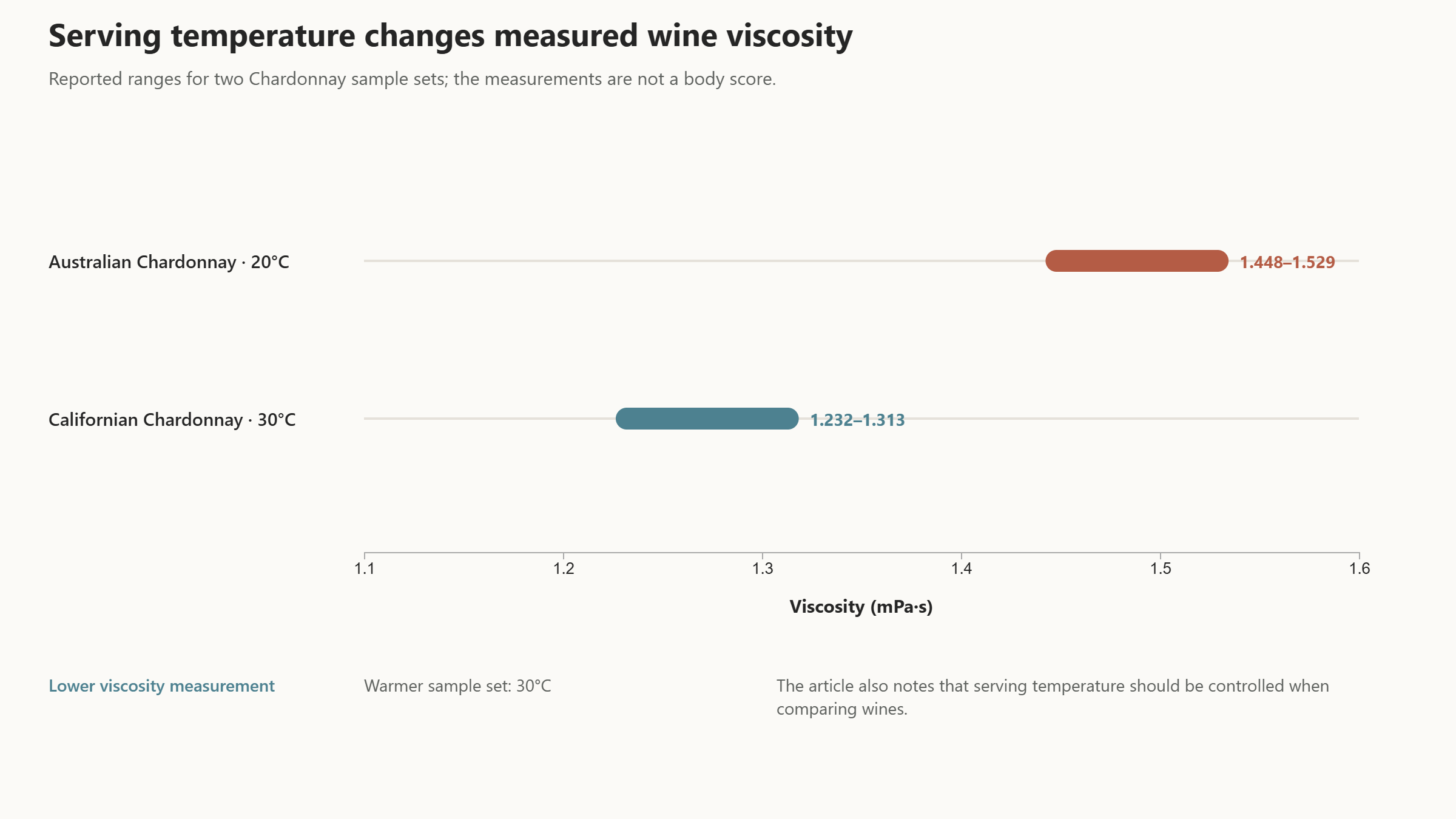
Use the analogy comparatively, not chemically. Serving temperature changes viscosity: reported Chardonnay measurements ranged from 1.448–1.529 mPa·s at 20°C in one sample set to 1.232–1.313 mPa·s at 30°C in another.
Alcohol + concentration
Can increase warmth, solvent power, roundness, and breadth. Tasters may need a difference of more than 3 percentage points alcohol to perceive a viscosity change; reported thresholds were 4.5 points for white and 3.2 for red.
Acidity
Stimulates salivation and gives the palate a sharper, faster line. Diagnose whether “lightness” comes from low substance or acidity carrying the wine quickly.
Tannins + extract
Tannins add structure and grip; non-volatile dissolved material can add density and persistence. Neither should automatically be labeled viscosity.
Sugar + carbonation
Sugar adds sweetness and, at sufficient concentration, viscosity. Bubbles add prickling, pressure, and lift—even when the wine is rich.
Assess body in four deliberate passes
For a repeatable sequence, use this Wine Tasting Method alongside the body-specific checks below.
Useful comparisons—and common traps
| Comparison | Typical cue | Do not assume |
|---|---|---|
| Sauvignon Blanc | Lean-to-medium; acidity and freshness | Intense citrus, herbs, or tropical aroma means heavy body |
| Pinot Noir | Silky or supple; acidity plus fine tannin | Tannic grip means viscosity |
| Dark color | May indicate pigment, extraction, oak, or age | Dark wine must feel dense |
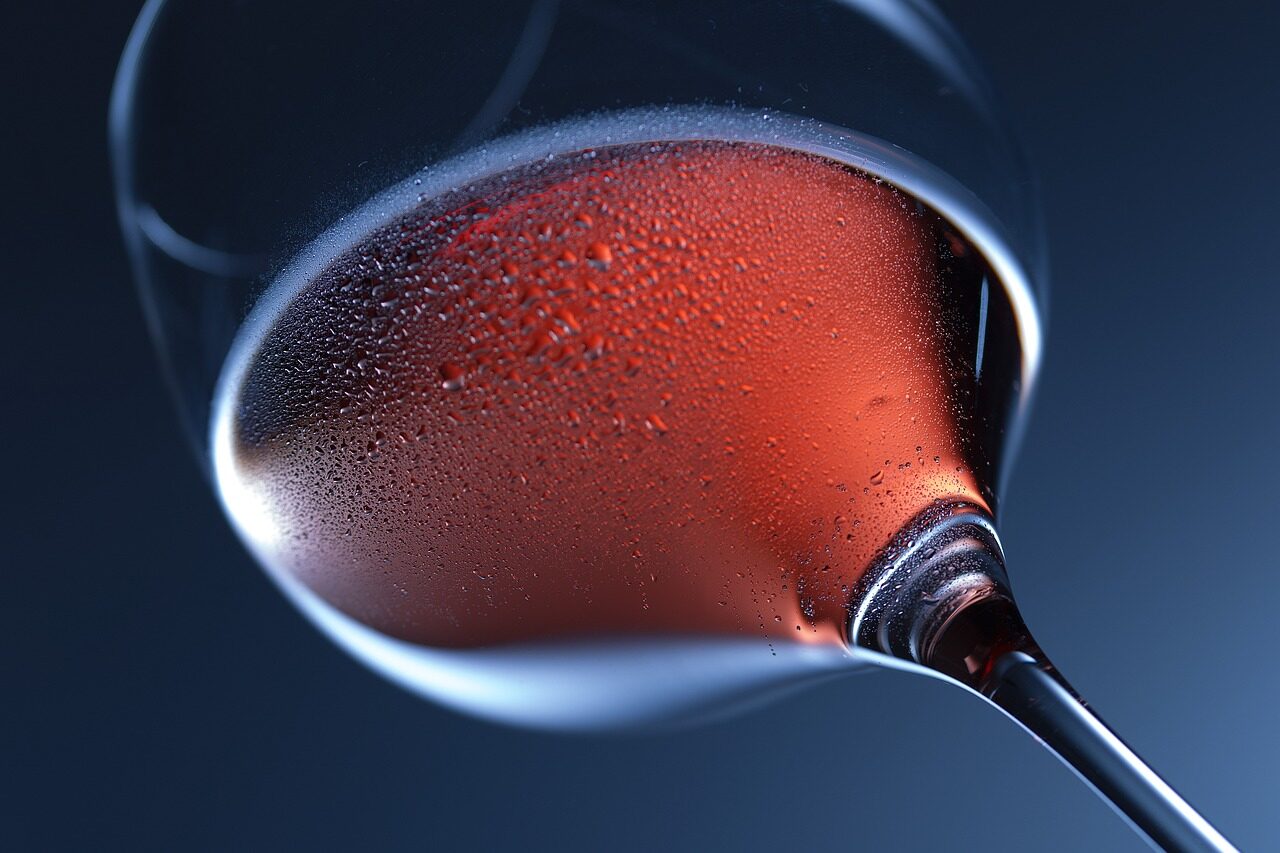
| Wine legs | Influenced by alcohol, sugar, temperature, and evaporation | Pronounced legs establish palate weight |
| Warm climate | Often higher ripeness and lower natural acidity | Region determines the final body |
Control the conditions: compare wines at similar temperatures, use identical glasses, drink water between samples, and beware palate fatigue after tannic or high-alcohol wines. Legs can remain visible for approximately 30 minutes after swirling, but they still are not a body score.
A compact body scorecard
| Field | Record | Vocabulary |
|---|---|---|
| Body | Overall palate weight | Light · medium · full |
| Texture | Surface and coating | Lean · silky · creamy · oily · dense |
| Alcohol | Warmth or heat | Low · moderate · high · hot |
| Acidity | Freshness and tension | Low · medium · high |
| Tannin | Grip and drying effect | Fine · firm · aggressive |
| Finish | Persistence of flavor and texture | Short · medium · long |

What does wine body mean in a sensory assessment?
Wine body describes the perceived weight, substance, and tactile presence of wine in the mouth. Tasters assess body primarily through texture rather than aroma: Does the wine feel delicate and quick, rounded and moderate, or dense and persistent? The American Wine Society’s systematic evaluation framework records body in three descriptive levels—light, medium, and full—within the taste-and-texture assessment rather than treating body as a synonym for quality.
Body is a sensory judgment, not a single laboratory measurement. Researchers studying wine mouthfeel connect the sensation with viscosity, alcohol, dissolved compounds, tannins, sugar, acidity, and lubrication between the wine, saliva, and oral surfaces. Paissoni and colleagues’ 2023 review describes body as a frequently used but still imprecise mouthfeel concept, which explains why two tasters may agree that a wine feels “substantial” while describing the sensation differently.
A useful assessment separates how much wine seems to occupy the mouth from what the wine tastes like. A light-bodied wine may carry intense citrus or floral aromas, while a full-bodied wine may show restrained fruit but a broad, dense palate. The American Wine Society framework therefore records body separately from flavor intensity, acidity, sweetness, tannin, alcohol, and finish.
“Body” is best treated as a composite mouthfeel impression rather than a direct reading of alcohol, sugar, or color. — American Wine Society, Systematic Framework for Wine Evaluation, 2023; Paissoni et al., 2023
How is body different from sweetness, acidity, tannic dryness, and flavor intensity?
Body measures perceived weight; sweetness, acidity, tannin, and flavor intensity describe different sensory dimensions. Sweetness comes from residual sugar and other sweet-tasting components. Acidity creates sourness, freshness, and structural tension. Tannins create astringency—the drying, puckering sensation produced partly through interactions with salivary proteins. Flavor intensity measures how strongly aromas and tastes register, not how heavy the wine feels.
These dimensions often interact, which creates common tasting errors. A sweet wine may feel rich because sugar increases sweetness and, above certain concentrations, viscosity. Yet Paissoni et al.’s 2023 review reports that residual sugar below 4 g/L contributes negligibly to wine viscosity. A dry wine with high alcohol and low acidity may feel broad, while a dry wine with high acidity may feel firm and narrow even when alcohol is substantial.
Tannin can make a wine feel more structured without making it viscous. A young Cabernet Sauvignon may feel full because of alcohol, extract, and concentration, but its drying finish comes from tannin rather than body alone. Conversely, an oily white wine may feel broad and smooth while showing no tannic dryness.
How do light-, medium-, and full-bodied wines compare with skim milk, whole milk, and cream?
Milk comparisons offer a practical analogy for perceived weight, but they do not identify the chemical cause of body. Light-bodied wine resembles skim milk in its relatively lean, quick-moving impression; medium-bodied wine resembles whole milk in its rounded but balanced presence; full-bodied wine resembles cream in its greater density, coating effect, and persistence.
| Wine-body category | Milk analogy | Typical mouth impression | Assessment question |
|---|---|---|---|
| Light | Skim milk | Delicate, brisk, narrow, quick to clear | Does the wine leave little coating after swallowing? |
| Medium | Whole milk | Rounded, balanced, moderate weight | Does the wine occupy the palate without feeling dense? |
| Full | Cream | Broad, dense, coating, persistent | Does the wine remain substantial after acidity fades? |
The analogy works best when comparing wines side by side. A 2023 review reported measured viscosity ranges of 1.448–1.529 mPa·s for Australian Chardonnay at 20°C and 1.232–1.313 mPa·s for Californian Chardonnay at 30°C; the temperature difference shows why body cannot be judged independently of serving conditions.
What Creates Wine Body? Alcohol, Acidity, Tannins, and Residual Sugar
How does alcohol increase warmth, weight, and fullness?
Alcohol contributes to body by adding warmth, increasing solvent power, and reinforcing a broad or rounded palate impression. Higher alcohol often feels fuller because ethanol affects viscosity, heat perception, and the way aroma compounds are released. The sensation may register as “weight,” “heat,” “roundness,” or “breadth,” depending on the wine’s acidity, sweetness, and tannin.
Alcohol does not produce a simple one-to-one body scale. Paissoni et al.’s 2023 review summarizes sensory studies showing that tasters generally needed more than a three-percentage-point alcohol difference to perceive a viscosity difference. One study reported detection thresholds of 4.5 percentage points for white wine and 3.2 percentage points for red wine. Small alcohol differences may therefore remain undetectable when acidity, tannin, temperature, and flavor concentration change at the same time.
A high-alcohol wine can feel hot rather than full if acidity and fruit concentration do not balance the ethanol. For assessment, record alcohol warmth separately from body: “full-bodied, high alcohol, warming finish” communicates more information than simply writing “heavy.”
Why can acidity make a high-alcohol wine feel lighter or firmer?
Acidity can make a high-alcohol wine feel lighter by sharpening the attack, shortening the sense of breadth, and creating a firm line through the palate. The wine may still contain substantial alcohol, but tartaric and other organic acids redirect perception toward freshness, tension, and movement.
Compare a cool-climate Chardonnay with a warmer-climate Chardonnay at similar alcohol levels. The higher-acid wine may seem more slender because acidity stimulates salivation and makes the finish feel brisk. The lower-acid wine may seem broader because alcohol and dissolved solids remain more prominent. Paissoni et al.’s review identifies acidity as one of several physical-chemical variables that interact with viscosity and oral lubrication rather than acting as an isolated “lightness” switch.
This interaction creates a useful diagnostic question: Does the wine feel light because it lacks substance, or because acidity is carrying the palate quickly? If the wine begins sharply but finishes with warmth and coating, describe it as structurally firm with medium or full body rather than automatically calling it light.
How do tannins, residual sugar, extract, and carbonation change mouthfeel?
Tannins add grip and dryness, residual sugar adds sweetness and—at sufficient concentration—viscosity, extract adds palate density, and carbonation adds tactile lift. These effects overlap but remain distinguishable during a structured tasting.
- Tannins: Create astringency through interactions with salivary proteins, producing drying, rough, chalky, or grippy sensations. They can make a wine feel structured without making it thick.
- Residual sugar: Increases sweetness; below 4 g/L, Paissoni et al.’s 2023 review finds a negligible contribution to viscosity.
- Extract: Refers broadly to non-volatile dissolved material, including compounds that can increase concentration and persistence. The review links wine body research with density, phenolics, polysaccharides, and other matrix components rather than one universal extract threshold.
- Carbonation: Creates prickling, pressure, and a sense of lift. The bubbles can make a wine feel energetic even when sugar or alcohol adds richness.
Use separate descriptors instead of collapsing everything into “full.” A tannic red may be full-bodied but austere; a sparkling demi-sec wine may be medium-bodied, sweet, and highly refreshing; an unoaked white may show medium body with a creamy texture but little tannin.
Wine Body Cues: Grape Variety, Climate, Color, and Winemaking Style
How do grape variety and climate influence perceived body?
Grape variety and climate influence body by shaping ripeness, alcohol potential, acidity, phenolic composition, and winemaking choices. Warm conditions generally promote higher sugar accumulation and lower natural acidity at harvest, while cooler conditions often preserve acidity and produce wines that feel more linear. The pattern describes a tendency, not a rule: irrigation, harvest date, canopy management, yeast choice, oak, lees contact, and blending can alter the final result.
Variety establishes another layer of expectation. Pinot Noir typically produces a more delicate tannic frame than Cabernet Sauvignon, while Sauvignon Blanc often emphasizes acidity and aromatic lift more than palate weight. Chardonnay can range from lean and mineral to broad and creamy because the variety tolerates substantial variation in climate, harvest maturity, oak treatment, and lees management.
Climate should therefore guide a hypothesis rather than determine a verdict. A warm-region Sauvignon Blanc can feel broad and alcohol-led, while a cool-region Chardonnay can feel firm and medium-bodied despite extended lees contact. Taste the wine before assigning body from its place of origin.
Sauvignon Blanc vs Pinot Noir: How body differs across familiar wines
Sauvignon Blanc and Pinot Noir often differ more in texture and structural cues than in simple flavor intensity. Sauvignon Blanc commonly presents high acidity, a relatively lean-to-medium palate, and aromatic intensity ranging from citrus and herbs to tropical fruit. Pinot Noir usually adds red-fruit softness, moderate tannin, and a more persistent mid-palate, although cool-climate examples can remain light-bodied.
| Dimension | Sauvignon Blanc | Pinot Noir |
|---|---|---|
| Common body impression | Light to medium | Light to medium, sometimes fuller with ripeness and oak |
| Main structural cue | Acidity and freshness | Acidity plus fine tannin |
| Typical texture | Lean, crisp, sometimes waxy or creamy | Silky, supple, sometimes earthy or grippy |
| Common tasting mistake | Confusing intense aroma with heavy body | Confusing tannic grip with viscosity |
The comparison works only when vintage, region, alcohol, and production style remain visible in the assessment. A barrel-fermented Sauvignon Blanc may feel broader than a light Pinot Noir, and a cool-climate Pinot Noir may feel less substantial than a ripe, lees-aged Sauvignon Blanc.
Can color, viscosity, and wine legs reliably indicate body?
Color provides context, viscosity provides a clue, and wine legs provide limited evidence; none should replace palate assessment. The American Wine Society’s framework records appearance intensity across five categories: colorless, pale, medium, deep, and opaque. These categories standardize visual description, but they do not convert color into a direct measurement of body.
Dark color may accompany skin contact, extraction, age, oak, or grape pigments without guaranteeing a thick palate. A pale wine may still feel rich if alcohol, sugar, glycerol-like texture, lees contact, or extract broaden the mouthfeel. Swirl speed, glass shape, temperature, alcohol, and sugar also affect the apparent movement of wine on the glass.
How to Assess Wine Body: A Practical Tasting Sequence

What should you observe when swirling and smelling the wine?
Begin with appearance and aroma, but treat both stages as hypotheses about body rather than proof. Hold the glass against a white background and record color intensity, clarity, and viscosity-like movement. The American Wine Society framework places appearance before taste and texture, while the broader sensory sequence used in formal wine assessment moves from appearance to nose, palate, and final conclusions.
Swirl gently, then smell before swirling again. Look for signs of ripeness, alcohol warmth, oak, dried fruit, or concentration. A powerful aroma does not equal full body: volatile compounds can create intense perfume in a wine that remains light and brisk on the palate.
- Observe color intensity and clarity.
- Smell for alcohol heat, ripeness, oak, fruit concentration, and fermentation-derived aromas.
- Predict a body category without committing to it.
- Test the prediction with the palate.
How do sipping, swishing, and holding wine in the mouth reveal texture?
A small sip reveals body through entry, mid-palate volume, movement, coating, and finish. Let the wine spread across the tongue and cheeks, then swish gently to expose the full oral surface. Notice whether the liquid feels watery, satin-like, oily, creamy, dense, or drying.
Hold the wine for several seconds and separate the sensations. Acidity may make the mouth water; tannin may create a drying grip; alcohol may produce warmth; body remains the integrated impression of weight and substance. Spit or swallow, then assess how much texture remains after the liquid disappears.
Use a three-part internal question: How does it enter? How does it expand? How long does the substance remain? This sequence prevents the finish from dominating the entire score.
What should a wine body assessment scorecard measure?
A useful scorecard records body separately from the structural and sensory factors that influence its perception. The American Wine Society framework uses a three-point descriptive body scale—light, medium, or full—alongside separate observations for texture, sweetness, acidity, tannin, alcohol, flavor intensity, balance, and duration.
| Scorecard field | What to record | Useful vocabulary |
|---|---|---|
| Body | Overall palate weight | Light, medium, full |
| Texture | Surface and coating sensation | Lean, silky, creamy, oily, dense |
| Alcohol | Warmth and heat | Low, moderate, high, hot |
| Acidity | Freshness and tension | Low, medium, high |
| Tannin | Grip and drying effect | Low, fine, firm, aggressive |
| Finish | Persistence of flavor and texture | Short, medium, long |
Wine Body Assessment Pitfalls: Legs, Color, Alcohol, and Personal Perception
Why are wine legs an imperfect shortcut for judging body?
Wine legs primarily reveal fluid-dynamics effects involving alcohol evaporation and surface-tension gradients, not a direct body score. Dey and colleagues’ 2018 study, Tears of Wine: The Dance of the Droplets, explains why droplets form and reports that legs can remain visible for approximately 30 minutes after swirling.
Alcohol level, sugar, glass cleanliness, temperature, swirl intensity, and evaporation conditions can all influence the display. A wine with pronounced legs may contain more alcohol or sugar, but the visual effect does not establish whether the wine feels broad, tannic, creamy, or dense on the palate.
When can dark color suggest richness but fail to predict mouthfeel?
Dark color can suggest extraction or concentration while failing to predict the tactile experience of the finished wine. Grape-skin pigments, maceration time, oxidation, oak, and age influence appearance through mechanisms that do not map neatly onto viscosity or alcohol.
Visual bias can also change verbal description. In a University of Bordeaux experiment involving 54 undergraduate participants, every participant described a white wine dyed red as though it were a red wine; The Guardian reported the study in 2001. The result demonstrates that color can redirect sensory interpretation before the palate has been assessed.
How do serving temperature, glassware, and palate fatigue distort assessment?
Serving temperature changes viscosity and volatility, glassware changes aroma delivery, and palate fatigue reduces discrimination between structural sensations. The 2023 Chardonnay viscosity ranges reported by Paissoni et al. demonstrate that temperature differences can produce materially different measured viscosity values.
Warm wine may emphasize alcohol and make body seem broader, while excessively cold wine can suppress aroma and tighten the palate. A narrow glass may concentrate volatile aromas; a broader bowl may increase aromatic exposure and alter the taster’s expectation of richness. After several high-alcohol or tannic samples, drying and heat can persist in the mouth, contaminating later scores.
When sediment or heavy reduction complicates the pour, consult How to Decant Wine Without Ruining before comparing body across samples.
- Keep all samples at comparable temperatures.
- Use identical glasses for a comparative flight.
- Serve water and neutral foods between samples.
- Limit the number of strongly tannic, sweet, or alcoholic wines in one sequence.
Calibrating Wine Body: Side-by-Side Flights and Consistent Scoring
How can a three-wine tasting flight demonstrate light, medium, and full body?
A three-wine flight demonstrates body most clearly when tasters compare wines simultaneously rather than relying on memory. Choose wines with contrasting palate weights but avoid stacking several variables so aggressively that acidity, sweetness, or tannin becomes the only visible difference.
- Light: Select a high-acid white or delicate red with limited alcohol warmth and a short-to-medium finish.
- Medium: Choose a wine with moderate alcohol, balanced acidity, and a rounded mid-palate.
- Full: Use a wine with greater alcohol warmth, extract, concentration, oak influence, sugar, or a combination of these factors.
Serve the samples blind if you want to reduce expectations created by grape variety, price, color, or region. Reveal the identities afterward and discuss which structural component created the impression of weight.
Which tasting questions help separate body from acidity, tannin, and sweetness?
Specific sensory questions produce more consistent body judgments than broad questions about whether a wine feels “big.” Ask:
- Does the wine feel substantial before the acidity arrives?
- Does acidity make the palate narrow, lengthen, or sharpen?
- Does tannin dry the mouth without increasing liquid weight?
- Does sweetness add viscosity, or does it merely increase perceived richness?
- Does alcohol feel warming, or does it integrate into a rounded texture?
- After swallowing, does the wine leave coating, dryness, freshness, or heat?
These questions turn an impression into observable evidence. A taster may then write, “Medium-bodied, high acidity, fine tannin, moderate alcohol,” instead of assigning the contradictory phrase “light but heavy.”
How can tasters compare body consistently across grape varieties and wine styles?
Consistency improves when tasters use the same scale, glassware, serving conditions, tasting order, and written prompts across every flight. Record body on the same three-point scale, then add the drivers and modifiers rather than changing the definition for each grape variety.
The OIV’s sensory-analysis review recommends inserting three identical samples into a series of at least six samples to monitor repeatability. A 2020 model-wine sensory study reported repeatability indices ranging from 0.75 to 0.88 across three sensory replicates, showing that repeated evaluation can produce measurable agreement even when wine perception involves complex matrix interactions.
| Calibration control | Recommended practice | Purpose |
|---|---|---|
| Scale | Light, medium, full | Prevents shifting definitions |
| Environment | Same glass, temperature, light, and pour size | Reduces non-wine variables |
| Sequence | Lower intensity before higher intensity | Limits palate fatigue |
| Replication | Repeat selected samples without announcing them | Tests personal consistency |
| Language | Score body separately from acidity, tannin, sweetness, and alcohol | Identifies the source of perceived weight |
For advanced practice, compare a Sauvignon Blanc, Pinot Noir, Chardonnay, and fuller red in separate flights rather than forcing every wine into one stylistic expectation. The next useful extension is a repeatability exercise: conceal the same sample at two points in the sequence, then compare whether your body scores remain within the same descriptive category.