What Is Syrah/Shiraz? Grape, Style & Flavor Explained
Syrah and Shiraz are two names for the same dark-skinned Vitis vinifera grape variety. The grape produces red wines with medium- to full-bodied structure, naturally firm tannins, noticeable acidity, dark-fruit flavors, and a broad range of savory, spicy, floral, and smoky aromas. Wine Australia describes the variety as adaptable to moderate, cool, and warm regions, while its final style changes substantially according to climate, vineyard site, and winemaking technique.
DNA testing identified modern Syrah/Shiraz as the natural offspring of two southeastern French varieties, Dureza and Mondeuse Blanche. Decanter reports that both parent grapes are associated with the Rhône-Alpes region, establishing a French origin for a variety once linked to Persia, Sicily, and other historical theories.
The grape’s physical and chemical composition allows producers to make markedly different wines from the same genetic material. A restrained Northern Rhône Syrah may emphasize pepper, olive, violet, smoked meat, and firm acidity, while a warm-region Shiraz may emphasize blackberry, plum, chocolate, liquorice, and a rounder texture. Those differences reflect growing conditions and cellar decisions rather than a change in grape identity.
Why Is the Same Grape Called Syrah or Shiraz?
“Syrah” is the traditional name used in France and many regions influenced by French wine culture, while “Shiraz” became the established Australian name. Decanter reports that the grape reached Australia in the 1830s and that the Australian naming tradition eventually became associated with a riper, fuller, more fruit-driven expression. France’s Northern Rhône continues to use Syrah for wines from appellations such as Hermitage and Côte-Rôtie.
The label offers a useful first clue, not a complete sensory prediction. “Syrah” often signals a cooler-climate or restrained stylistic intention, whereas “Shiraz” often points toward Australia or another producer seeking a generous, ripe profile. However, producers in Australia may use “Syrah” to communicate elegance, freshness, or a Rhône-inspired approach, and producers outside Australia may choose “Shiraz” for branding or market recognition.
For comparison, grape names also help distinguish other internationally traded varieties, such as the Sangiovese grape and the Tempranillo grape. Syrah/Shiraz follows the same broad principle: the name reflects wine culture and market convention, while the bottle’s region and producer reveal more about the finished wine.
When Do Syrah and Shiraz Labels Not Follow a Simple Style Rule?
The Syrah-versus-Shiraz distinction becomes unreliable when producers use the name to describe intention rather than geography. A cool-climate Australian producer may label a wine Syrah to highlight savory complexity, moderate alcohol, and fine tannins. Conversely, a producer in a warm region may use Shiraz while making a restrained, food-oriented wine with bright acidity.
Blending also complicates the naming pattern. Wine Australia documents Shiraz blended with Grenache and Mourvèdre in GSM wines, with Cabernet Sauvignon in classic Australian blends, and sometimes with a small proportion of Viognier. These combinations can change the wine’s aroma, body, tannin, and texture beyond what the Syrah or Shiraz name alone communicates.
Read the label in sequence: first the grape name, then the region, vintage, alcohol level, and producer. That approach lets you assess wine body more accurately than relying on “Syrah” or “Shiraz” as a fixed style code.
How Climate Shapes Syrah/Shiraz Style, Body, Acidity, and Alcohol
What Does Cool-Climate Syrah Taste and Feel Like?
Cool-climate Syrah typically shows brighter acidity, firmer tannins, more savory detail, and a lighter to medium-bodied frame. Northern Rhône examples commonly combine dark berry fruit with black pepper, violet, olive, herbs, smoked meat, and mineral-like savory impressions. Washington’s cooler Yakima Valley sites similarly produce Syrah with more acidity, savory character, and lower alcohol than warmer Columbia Valley locations.
Cool conditions slow ripening and help preserve acidity while limiting the tendency toward very high sugar accumulation. Recent Decanter World Wine Awards examples illustrated the climate-style spectrum: a Côte-Rôtie Syrah at 13% ABV compared with several warmer-region Shiraz and Syrah examples at approximately 14% to 14.5% ABV. Alcohol alone cannot define quality, but it provides a useful indicator when read alongside region and vintage.
What Does Warm-Climate Shiraz Taste and Feel Like?
Warm-climate Shiraz generally delivers riper fruit, fuller body, softer apparent acidity, and higher alcohol. Barossa Valley wines often show blackberry, ripe plum, liquorice, pepper, spice, and plush tannins, while McLaren Vale Shiraz commonly emphasizes rich blueberry fruit and chocolate character. Wine Australia identifies both regions as important sources of full-bodied Shiraz, although their individual flavor profiles remain distinct.
Warm conditions can increase sugar ripeness and produce a broader, denser palate. That does not automatically make the wine sweet: a dry Shiraz may taste fruit-rich because ripe fruit aromas and glycerol-like texture create an impression of sweetness without measurable residual sugar. Oak, extraction, and bottle age can either amplify or soften this impression.
How Do Ripeness, Tannin, Texture, and Acidity Change Across Regions?
Ripeness usually increases body and fruit concentration, while cooler conditions tend to preserve acidity and sharpen tannin definition. Wine Australia’s regional descriptions place Adelaide Hills Shiraz toward moderate alcohol, pepper and spice aromas, fine tannins, and fresh acidity, while Barossa Shiraz occupies a fuller, richer stylistic position. Hunter Valley Shiraz provides another contrast: the region’s wines are typically medium-bodied, red-fruited, savory, and food-friendly rather than uniformly massive.
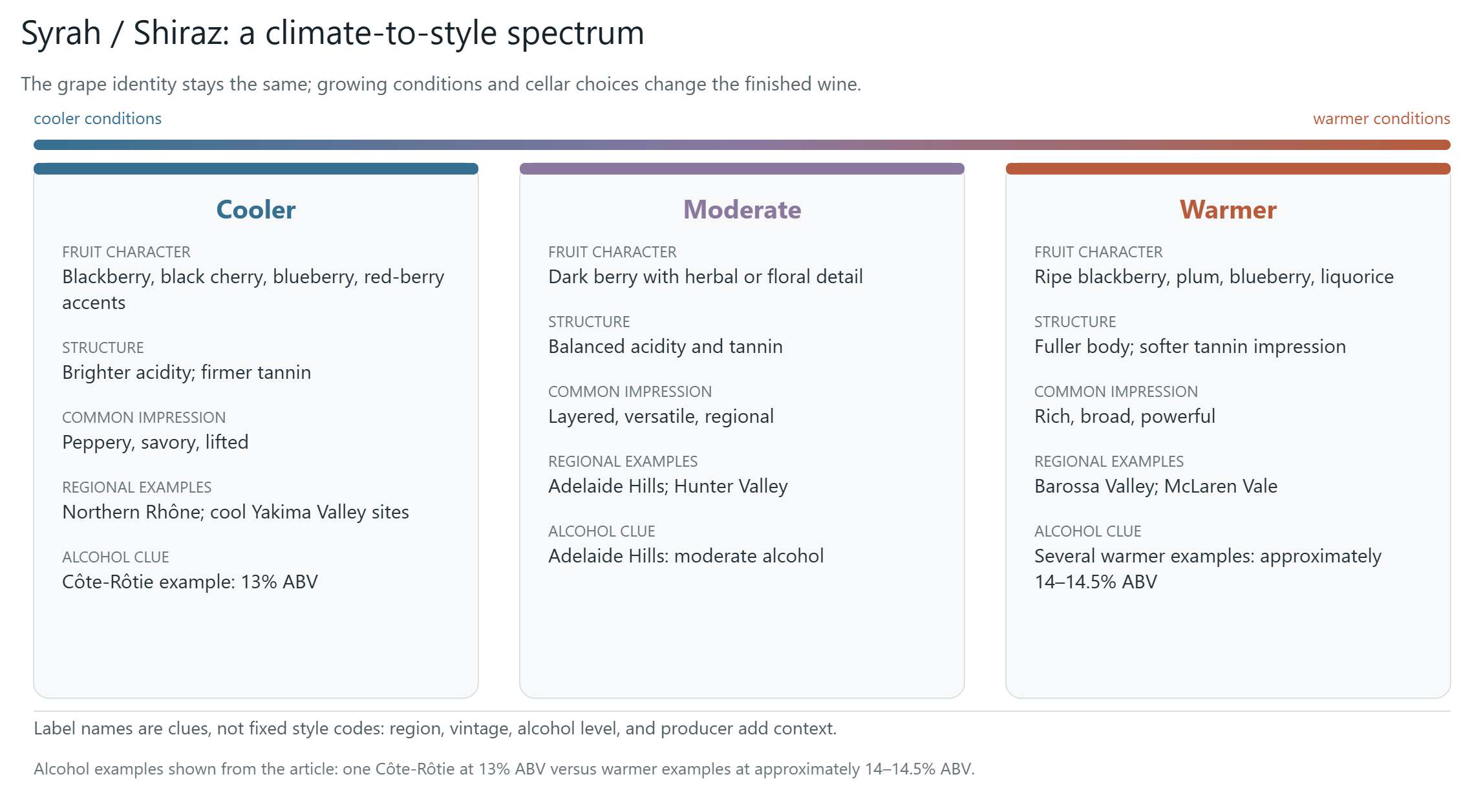
| Climate tendency | Fruit character | Structure | Common impression |
|---|---|---|---|
| Cooler | Blackberry, black cherry, blueberry, red berry accents | Brighter acidity, firmer tannin | Peppery, savory, lifted |
| Moderate | Dark berry with herbal or floral detail | Balanced acidity and tannin | Layered, versatile, regional |
| Warmer | Ripe blackberry, plum, blueberry, liquorice | Fuller body, softer tannin impression | Rich, broad, powerful |
Use a five-step tasting method to separate these elements: observe color, smell the fruit and spice, taste acidity and tannin, assess texture, and consider the finish. That sequence prevents alcohol or oak from dominating your interpretation.
Syrah/Shiraz Flavor Profile: Fruit, Pepper, Smoke, Herbs, and Savory Notes
What Fruit Flavors Are Typical in Syrah/Shiraz?
Typical Syrah/Shiraz fruit flavors include blackberry, black cherry, blueberry, plum, damson, raspberry, and sometimes blackcurrant. Warmer regions generally emphasize darker, riper fruit, while cooler sites may show fresher berry tones alongside pepper, flowers, herbs, and savory flavors. Decanter’s 2026 award examples included blackberry, dark cherry, plum, blueberry, damson, black cherry, and raspberry across wines from Australia, France, South Africa, New Zealand, Argentina, and the United States.
Fruit expression also changes with age. Primary berry aromas become less dominant as the wine develops tertiary notes such as leather, tobacco, dried herbs, earth, meat, and forest floor. A mature Syrah can therefore taste less overtly fruity without losing its underlying dark-fruit structure.
Why Do Syrah and Shiraz Often Taste Peppery, Spicy, or Smoky?
The black-pepper aroma in Syrah/Shiraz is strongly associated with rotundone, a grape-derived aroma compound. The Australian Wine Research Institute gives rotundone a sensory detection threshold of 16 nanograms per liter in red wine, meaning very small concentrations can influence aroma perception. The same source reports that rotundone appeared in 62% of the wines containing the compound, with Shiraz representing the majority of those wines.
Rotundone is only one part of the flavor profile. Whole-bunch fermentation, fermentation vessels, oak maturation, reduction, smoke exposure, and bottle age can contribute additional herbal, smoky, meaty, woody, or savory impressions. A peppery wine therefore reflects both grape chemistry and production choices, not simply the word “Syrah” on the label.
Which Tasting Notes Come From the Grape, Oak, Winemaking, and Age?
Fruit, pepper, violet, and some herbal aromas often arise from the grape and vineyard, while vanilla, toast, chocolate, smoke, and dried-leaf notes may reflect oak, fermentation, or maturation. Wine Australia reports that Shiraz producers use a range of maturation choices, including French oak, American oak, older barrels, and no oak for some early-drinking styles.
- Grape and site: blackberry, plum, blueberry, black pepper, violet, and regional savory character.
- Oak: toast, vanilla, cedar, baking spice, mocha, and additional tannin.
- Winemaking: smoke, meat, olive, herbal tones, or a smoother texture depending on extraction, whole bunches, fermentation, and vessel choice.
- Age: leather, tobacco, dried fruit, earth, mushroom, and more integrated tannin.
When a tasting note says “chocolate,” the phrase may describe ripe fruit, oak, alcohol warmth, or all three. Smell first, taste second, and identify whether the note appears on the aroma, palate, or finish.
Major Syrah/Shiraz Regions and Their Signature Styles
Northern Rhône Syrah: Peppery, Savory, Structured, and Age-Worthy
France’s Northern Rhône is Syrah’s classic reference point for peppery, savory, floral, and structured red wine. Hermitage and Côte-Rôtie represent benchmark appellations, with wines that can combine blackberry, black pepper, smoked meat, olive, violet, herbs, acidity, and firm tannins. Decanter describes the region as the grape’s spiritual home and identifies its wines as layered and age-worthy.
Côte-Rôtie often presents a more aromatic and lifted expression, while Hermitage can show greater density and structure. Site, vintage, producer, and the use of whole bunches or co-fermentation create variation within each appellation, so “Northern Rhône” functions as a starting point rather than a single uniform taste.
Australian Shiraz: From Barossa Valley Richness to Cooler-Climate Elegance
Australia offers one of the widest ranges of Shiraz styles, from powerful Barossa Valley wines to elegant expressions from cooler regions. Shiraz accounted for 23% of Australia’s total winegrape crush in 2025, making it the country’s leading crushed variety, according to Wine Australia.
Barossa Valley Shiraz commonly combines full body, ripe blackberry, plush tannins, pepper, spice, and rich texture. Eden Valley, the cooler elevated neighbor, often adds sage, pepper, and more aromatic definition. Hunter Valley Shiraz tends toward medium body, red fruit, savory complexity, and food-friendly structure, while Adelaide Hills Shiraz emphasizes moderate alcohol, pepper, spice, fine tannins, and acidity.
South African Syrah: Dark Fruit, Spice, and Coastal Freshness
South African Syrah combines dark fruit and spice with regional variation between established areas such as Stellenbosch and Swartland and cooler, higher-altitude sites. Wines of South Africa identifies Stellenbosch and Swartland as the country’s heartlands while also documenting Syrah in cooler regions including the Eastern Free State, Sutherland, Ceres Plateau, Elim, and Malgas.
Recent Decanter World Wine Awards examples showed the range clearly: a Stellenbosch Syrah with beef, mocha, dark cherry, prune, leathery texture, and sleek tannins contrasted with a Swartland Syrah showing blackberry, violet, rose petal, black olive, crispness, and brightness.
Washington State Syrah: Bright Fruit, Acidity, and Walla Walla Valley Character
Washington State Syrah spans ripe, dark Columbia Valley wines and more acidic, savory expressions from cooler sites. Washington had more than 6,300 hectares of Syrah plantings, according to Decanter, which also reports that warmer Columbia Valley sites produce riper, darker wines while cooler Yakima Valley sites produce wines with more acidity, savory notes, and lower alcohol.
Walla Walla Valley adds a distinctive geological identity, particularly in the cobblestone-rich Rocks District of Milton-Freewater, where Decanter associates Syrah with earth, meat, iodine, and herbs. A Washington label therefore rewards close reading: Columbia Valley, Yakima Valley, Walla Walla Valley, and Red Mountain do not communicate the same balance or texture.
Syrah/Shiraz Food Pairing: Match Body, Tannin, Acidity, and Smoke
Why Do Grilled Meats, Smoked Foods, and Hearty Stews Pair Well?
Grilled meats and hearty stews suit Syrah/Shiraz because protein softens tannin while char and smoke echo the wine’s peppery and savory notes. Wine Australia specifically lists grilled and roasted lamb, beef, game, stews, casseroles, and charcuterie among suitable pairings.
Choose a fuller Barossa Shiraz for slow-cooked beef, barbecue ribs, or strongly charred lamb. Select a more acidic Northern Rhône Syrah or Washington Syrah for grilled sausages, roast duck, mushroom stew, or lamb with herbs. The stronger the sauce and smoke, the more structure the wine can carry.
Which Roasted Vegetables and Plant-Based Foods Work Best?
Roasted vegetables and umami-rich plant foods pair best when they provide enough caramelization, salt, or savory depth to meet Syrah/Shiraz’s tannin and intensity. Eggplant, portobello mushrooms, lentils, black beans, roasted beetroot, peppers, and tomatoes work particularly well when grilled, smoked, or roasted rather than served raw.
- Pair peppery Syrah with roasted eggplant, lentils, mushrooms, or herbs.
- Pair fruit-rich Shiraz with barbecue jackfruit, smoky beans, roasted peppers, or glazed root vegetables.
- Use acidic sauces, such as tomato or pomegranate-based preparations, to keep full-bodied wines from feeling heavy.
How Do Strong Cheeses and Spiced Dishes Balance Syrah/Shiraz?
Firm, aged cheeses balance Syrah/Shiraz by matching its concentration and softening the perception of tannin through fat and salt. Aged cheddar, mature Gouda, Manchego, and firm alpine-style cheeses suit richer examples, while blue cheese requires careful matching because salt and pungency can exaggerate alcohol and bitterness in an overly warm or tannic wine.
Spiced dishes work when the seasoning emphasizes black pepper, cumin, coriander, smoked paprika, or grilled meat rather than sharp, fresh chili heat. High chili intensity can make alcohol taste hotter, so choose a cooler, fresher Syrah when a dish carries substantial heat.
How to Buy and Serve Syrah/Shiraz With Confidence
How Can You Read a Syrah/Shiraz Label for Style and Region?
Read the region before making assumptions about the grape name. Northern Rhône Syrah points toward a cooler, savory, structured style; Barossa Valley Shiraz suggests greater ripeness and body; Hunter Valley indicates a more medium-bodied and savory Australian expression; Washington labels require attention to the specific valley or AVA.
Alcohol percentage provides a secondary clue. A bottle at 13% ABV may emphasize freshness and restraint, while a bottle at 14.5% or higher may offer more ripeness and warmth, although producer choices can override the regional pattern. Vintage, producer reputation, vineyard designation, and oak information complete the picture.
How Do You Choose Between a Lighter, Peppery Style and a Richer, Full-Bodied Style?
Choose a lighter, peppery Syrah when you want acidity, savory complexity, and food flexibility; choose richer Shiraz when you want dense fruit, broader texture, and greater power. For roast chicken, mushrooms, lamb with herbs, or moderately spiced food, look toward Northern Rhône, cooler Australian regions, or Yakima Valley. For barbecue, braised beef, grilled steak, or strong aged cheese, Barossa Valley and other warm-region Shiraz styles offer more weight.
Consider serving context rather than prestige. A concentrated wine may impress in a small tasting pour but overwhelm a delicate meal, while a peppery, medium-bodied Syrah may seem austere without food and become balanced at the table.
What Vintage and Aging Clues Matter When Buying Syrah/Shiraz?
Vintage matters most when you are buying a structured, premium bottle intended for aging. Decanter reports that most Shiraz is best consumed within approximately five years of vintage, while premium examples from Barossa, Hunter Valley, and the Northern Rhône can develop for 20 years or more.
Look for producer, appellation, vineyard designation, and storage history rather than age alone. A modestly structured wine may decline before a powerful one from the same year, while a cool vintage can produce lower alcohol and higher acidity but require more time for tannins to soften.
What Is the Best Serving Temperature, and When Should You Decant?
Serve Syrah/Shiraz slightly below typical indoor room temperature, around 15°C to 18°C, rather than warm. Excess heat increases the impression of alcohol and reduces the clarity of acidity, pepper, and tannin. This range suits both cooler-climate Syrah and richer Shiraz, with fuller wines often benefiting from the upper end and lighter examples from the lower end.
Decant young, tannic, full-bodied Syrah/Shiraz for roughly 30 to 90 minutes, then taste periodically. Older bottles require greater caution because extended exposure can cause delicate tertiary aromas to fade. Pour slowly if sediment is present, and use a smaller decanting window for mature wine.
Syrah/Shiraz Pitfalls to Avoid: Common Misconceptions and Style Traps
Why Is It Misleading to Treat Every Australian Shiraz as Heavy and Sweet?
Australia produces both powerful and elegant Shiraz, so the assumption that every Australian bottle is heavy and sweet ignores regional and producer diversity. Wine Australia describes Adelaide Hills Shiraz as moderate in alcohol with pepper, spice, fine tannins, and acidity, while Hunter Valley Shiraz is typically medium-bodied, red-fruited, savory, and food-friendly.
Cool-climate Australian producers also use less new oak, older barrels, whole-bunch techniques, and earlier-drinking approaches to create wines with more freshness and less overt oak influence. The label’s region and alcohol level will usually tell you more than the country name alone.
Why Does the Syrah or Shiraz Name Not Guarantee One Fixed Flavor Profile?
The grape name cannot guarantee one flavor profile because climate, crop conditions, site, clone, harvest timing, fermentation, oak, and bottle age all influence the wine. Wine Australia research identified sensory differences among Shiraz wines from six Australian regions and found that regional groupings could be distinguished through sensory and chemical analysis, while also recording meaningful variation within regions.
Even pepperiness varies. The Australian Wine Research Institute reports that rotundone levels change significantly by season, with cooler seasons generally producing higher concentrations. Site characteristics, topography, light, temperature, vine vigor, and bunch shading also influence rotundone development.
When Can Excessive Serving Temperature Hide Pepper, Acidity, and Structure?
Excessive serving temperature can make alcohol feel hotter while muting the wine’s structural definition. A warm Shiraz may appear softer, sweeter, and heavier than it actually is, whereas moderate chilling can clarify acidity and make pepper, herbs, and tannin easier to identify.
Perception also varies from person to person: approximately 20% of people are unable to smell rotundone, the compound commonly associated with Syrah/Shiraz’s peppery aroma. The Australian Wine Research Institute’s finding means that two tasters can evaluate the same bottle honestly yet report different levels of pepper.
Explore Syrah/Shiraz Further: Compare Regions, Vintages, and Food Pairings
The most revealing way to understand Syrah/Shiraz is to compare bottles side by side rather than study the name in isolation. Pour a Northern Rhône Syrah beside Barossa Valley Shiraz, then add a Washington State example and a South African Syrah. Keep the serving temperature consistent, taste the wines with and without food, and record body, acidity, tannin, fruit ripeness, pepper, oak, and finish.
Decanter’s 2026 World Wine Awards article presented 15 top-awarded Shiraz and Syrah wines from regions including France, Australia, South Africa, New Zealand, Argentina, and the United States, creating a useful comparative framework across climates and winemaking cultures.
For an age-focused tasting, compare a young, fruit-driven Shiraz with a mature premium bottle. Decanter reports that most Shiraz is best consumed within approximately five years, while premium examples from Barossa, Hunter Valley, and the Northern Rhône can age for 20 years or more. That contrast turns Syrah/Shiraz from a grape-name question into a study of climate, structure, cellar technique, and time.
Related: wine body and weight.
Related: red, white, and rosé.